A twenty-minute equipment monologue can leave a prospect knowing where the treadmills are but still unsure where to enter, who will help, what it costs, and whether the gym fits their day.
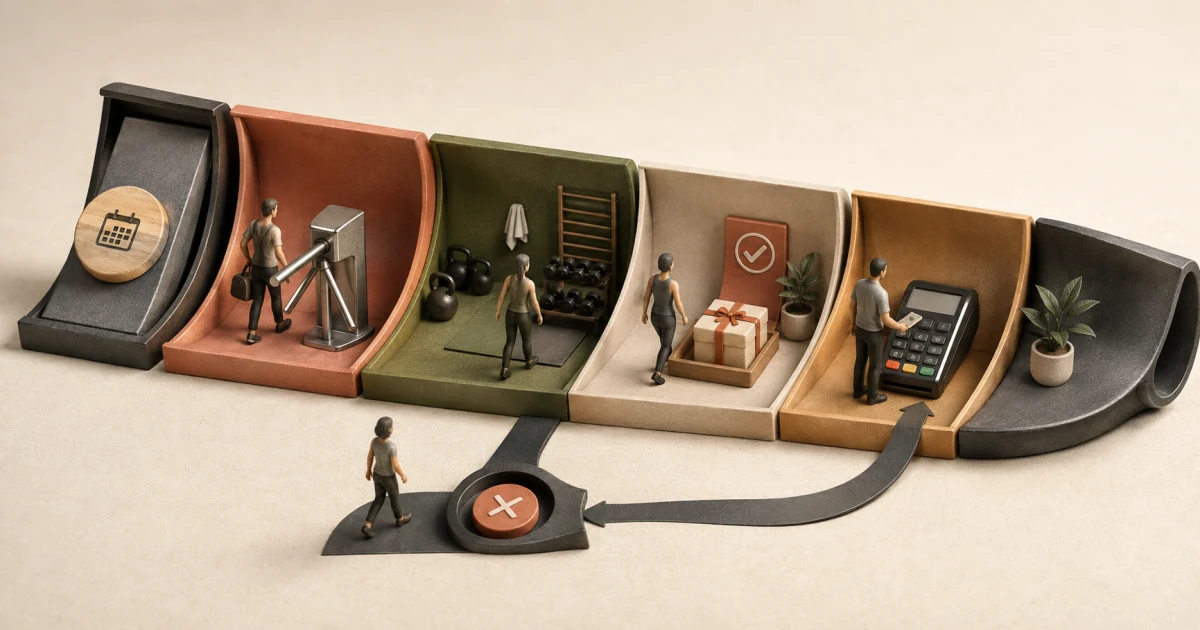
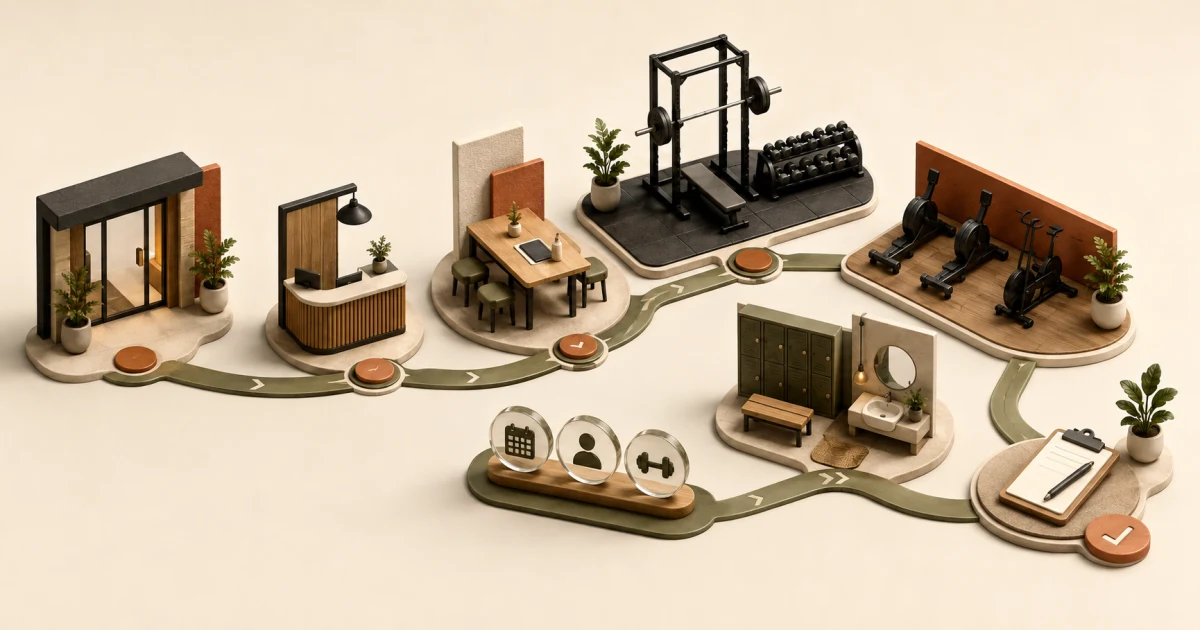
A reliable gym tour includes pre-arrival confirmation, a named welcome, short discovery, a route shaped by the prospect’s needs, honest proof of the experience, price and policy clarity, a specific next step, and a concise CRM record.
This guide treats lead handling as an operating system, not a collection of persuasive tricks. The core owner question is: Did the tour answer the prospect’s real decision and leave the next action unambiguous?
Place this decision inside the Cluster E system
The ten guides separate failures that are often blended into one conversion number:
Start with the lead-response SLA, then use the sales discovery guide, trial conversion system, and lost-lead reason codes where their decisions apply. A strong result in one stage cannot repair bad data or a broken handoff in another.
Define the record before measuring it
| Term | Working definition |
|---|---|
| Pre-arrival | The information and accessibility check needed before the visit. |
| Route | The smallest sequence of spaces that demonstrates relevant experience and constraints. |
| Proof | Something the prospect can observe or verify, not an unsupported claim. |
| Material term | Price, commitment, access, cancellation, capacity, or condition affecting the choice. |
| Next step | One action with owner and timing, including “no follow-up requested.” |
Write these definitions into the operating checklist. Otherwise one staff member will count a message as contact, another will require a call, and the monthly chart will compare different events under the same name.
Run the workflow with a named owner
| Step | Required action | Accountable role |
|---|---|---|
| Prepare | Review the stated question, schedule, source, accessibility need, and consent context. | Tour host |
| Welcome | Meet by name, explain the tour, and ask what would make it useful. | Tour host |
| Discover and route | Clarify fit, then show the spaces, people, and process that answer it. | Tour host |
| Explain | Cover actual price, included service, access, capacity, policies, and tradeoffs. | Tour host |
| Close and record | Agree one next step and log questions, fit, owner, and due time. | Tour host |
The owner column cannot say “team.” Several people may contribute, but only one role should be accountable for the next due action. If responsibility changes at a shift handover, the new owner must accept it rather than inherit an invisible queue.
Print this tour control sheet
| Moment | Required check | Evidence or note | Owner |
|---|---|---|---|
| Before arrival | Time, entrance, parking or access, host, requested support | ||
| Welcome | Purpose and permission for discovery | ||
| Facility route | Relevant areas plus real peak-time context | ||
| Offer | Price, inclusion, commitment, cancellation, exclusions | ||
| Close | Questions, next step, owner, due time |
Blank cells are intentional. Fill them from the gym’s actual offer, hours, capacity, policies, and records. A copied industry number can be a question to investigate, but it is not a local operating standard.
Work through a fictional example
A fictional 6 a.m. prospect visits at noon. The host does not pretend the empty floor represents the early peak. They show a recent occupancy pattern, explain where queues can happen, introduce the morning trainer by message with permission, and offer a second five-minute walk-through during the actual time window. The tradeoff becomes visible before purchase.
The example is deliberately fictional and is not an industry benchmark. Its purpose is to show the calculation or control path. Replace every assumption with an observed record from your gym and preserve the source period.
Measure the whole outcome, not the easiest event
Track:
- Booked-to-attended tour rate
- Tours with completed discovery and material-term checks
- Time from tour to agreed next action
- Paid joins and early cancellations by host and fit segment
- Repeated unanswered questions or misrepresented conditions
Use consistent denominators. A contact rate, an attended-visit rate, and a paid-join rate answer different questions. Keep source, staffed period, offer, and sample size visible before comparing teams or weeks.
Protect the prospect and the quality of the decision
- Do not stage or imply an atmosphere that is unlike normal operation.
- Do not skip cancellation or access terms to protect the close.
- Do not photograph or expose members during a tour without permission.
- Do not pressure a prospect who asks for time.
- Do not record insulting or speculative labels in CRM notes.
Fitness enquiries can reveal sensitive context even when a person never writes a diagnosis. Collect the minimum needed for the current decision, restrict access, define retention, and move exercise or medical screening into a separate qualified process when it is genuinely required.
Implement this in one operating week
- Walk the route as a first-time visitor.
- Remove stops that do not answer a decision.
- Add material terms and peak-time truth to the checklist.
- Practise one concise CRM note standard.
- Review tour no-shows and early cancellations monthly.
At the weekly review, inspect a small sample of the underlying calls, messages, visit records, stage timestamps, and collections. A tidy dashboard cannot compensate for ambiguous events or invented reasons.
Frequently asked questions
What should be included in a gym tour?
Include arrival guidance, a named welcome, concise discovery, relevant spaces and staff, real operating conditions, price and material terms, questions, and one agreed next step.
How long should a gym tour take?
There is no universal duration. It should be long enough to answer the person’s decision and short enough to avoid irrelevant detail. Track usefulness, questions, attendance, and outcomes rather than optimizing minutes alone.
Should a gym try to close the membership during the tour?
Offer a clear next step when the person has enough information, but do not manufacture urgency or hide tradeoffs. Joining now, arranging a trial, receiving an answer, or taking time can all be legitimate outcomes.