
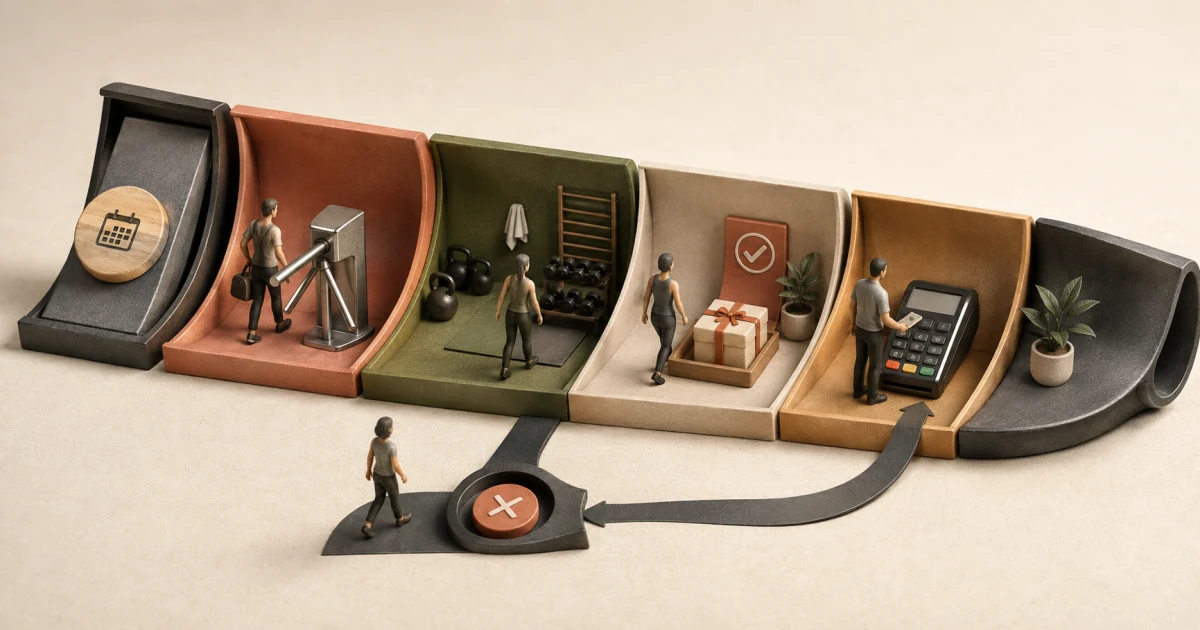
“Our trials do not convert” describes an outcome, not a cause. The leak may happen before arrival, during the first five minutes, in the coaching experience, in the offer, or after the person leaves.
Improve trial conversion by measuring each stage separately, matching the experience to discovery, delivering a safe and understandable session, clarifying the membership and conditions, recording feedback, and following up around the person’s unresolved decision rather than generic urgency.
This guide treats lead handling as an operating system, not a collection of persuasive tricks. The core owner question is: Which stage loses the right prospects, and what evidence distinguishes a booking problem from an experience or offer problem?
Place this decision inside the Cluster E system
The ten guides separate failures that are often blended into one conversion number:
Start with the lead-response SLA, then use the tour checklist, offer economics guide, and pipeline forecast where their decisions apply. A strong result in one stage cannot repair bad data or a broken handoff in another.
Define the record before measuring it
| Term | Working definition |
|---|---|
| Trial booked | A confirmed slot with a person, time, offer, and attendance rule. |
| Trial attended | The person arrived and received the defined experience. |
| Trial completed | The service and debrief were delivered, not merely checked in. |
| Qualified join | A paid membership that fits the stated offer and collection rule. |
| Early reversal | Refund, cancellation, or failed collection inside the chosen quality window. |
Write these definitions into the operating checklist. Otherwise one staff member will count a message as contact, another will require a call, and the monthly chart will compare different events under the same name.
Run the workflow with a named owner
| Step | Required action | Accountable role |
|---|---|---|
| Define | Write what the trial includes, who it suits, conditions, capacity, and success event. | Owner |
| Prepare | Use minimum discovery to select the right time, coach, and experience. | Sales and coach |
| Deliver | Welcome, orient, coach within competence, check understanding, and agree the next visit. | Coach |
| Explain | Present the relevant membership, full price, commitment, and alternatives. | Sales |
| Learn | Record decision, reason, follow-up permission, paid outcome, and early reversal. | Lead owner |
The owner column cannot say “team.” Several people may contribute, but only one role should be accountable for the next due action. If responsibility changes at a shift handover, the new owner must accept it rather than inherit an invisible queue.
Diagnose the trial funnel
| Stage | Count | Rate from prior stage | Primary owner | Evidence to inspect |
|---|---|---|---|---|
| Eligible enquiries | ||||
| Trials booked | ||||
| Trials attended | ||||
| Trials completed | ||||
| Paid memberships collected | ||||
| Still active after quality window |
Blank cells are intentional. Fill them from the gym’s actual offer, hours, capacity, policies, and records. A copied industry number can be a question to investigate, but it is not a local operating standard.
Work through a fictional example
A fictional gym books 40 trials, 22 attend, 18 complete, 11 pay, and 3 cancel inside 14 days. “11 from 40” hides two different problems: low attendance and poor early fit. The owner first fixes confirmation and arrival instructions, then reviews whether the session and offer matched discovery. They do not instruct staff to push harder at the final conversation.
The example is deliberately fictional and is not an industry benchmark. Its purpose is to show the calculation or control path. Replace every assumption with an observed record from your gym and preserve the source period.
Measure the whole outcome, not the easiest event
Track:
- Booking, attendance, completion, paid-join, collection, and early-reversal rates
- Stage rates by source, offer, time, coach, and fit segment
- Reasons for no-show, non-completion, non-join, and early cancellation
- Capacity and staff time per completed trial
- Complaints, unsafe promises, and pressure indicators
Use consistent denominators. A contact rate, an attended-visit rate, and a paid-join rate answer different questions. Keep source, staffed period, offer, and sample size visible before comparing teams or weeks.
Protect the prospect and the quality of the decision
- Do not define a “conversion” as a form submission or verbal yes.
- Do not design an exhausting workout to prove value.
- Do not let unqualified staff make health or exercise-safety promises.
- Do not hide standard price behind a temporary trial price.
- Do not treat every non-join as staff failure.
Fitness enquiries can reveal sensitive context even when a person never writes a diagnosis. Collect the minimum needed for the current decision, restrict access, define retention, and move exercise or medical screening into a separate qualified process when it is genuinely required.
Implement this in one operating week
- Write the exact stage definitions.
- Baseline four weeks by source and time.
- Observe five complete trials end to end.
- Fix the largest qualified-stage leak first.
- Track early reversals so bad-fit closes are not rewarded.
At the weekly review, inspect a small sample of the underlying calls, messages, visit records, stage timestamps, and collections. A tidy dashboard cannot compensate for ambiguous events or invented reasons.
Frequently asked questions
How do you calculate gym trial conversion?
Choose a clear denominator and outcome. For example, paid memberships divided by completed trials measures the closing stage, while paid memberships divided by booked trials includes attendance loss. Report both instead of hiding the leak.
What is a good gym trial conversion rate?
A universal target can mislead because the source, offer, eligibility, price, trial design, collection rule, and early cancellation window differ. Establish a clean baseline and improve qualified outcomes without pressure.
Should a gym offer a free trial?
Only after modelling capacity, staffing, delivery cost, eligibility, abuse controls, experience quality, paid conversion, collection, and early cancellation. Free is an offer design choice, not an automatic best practice.