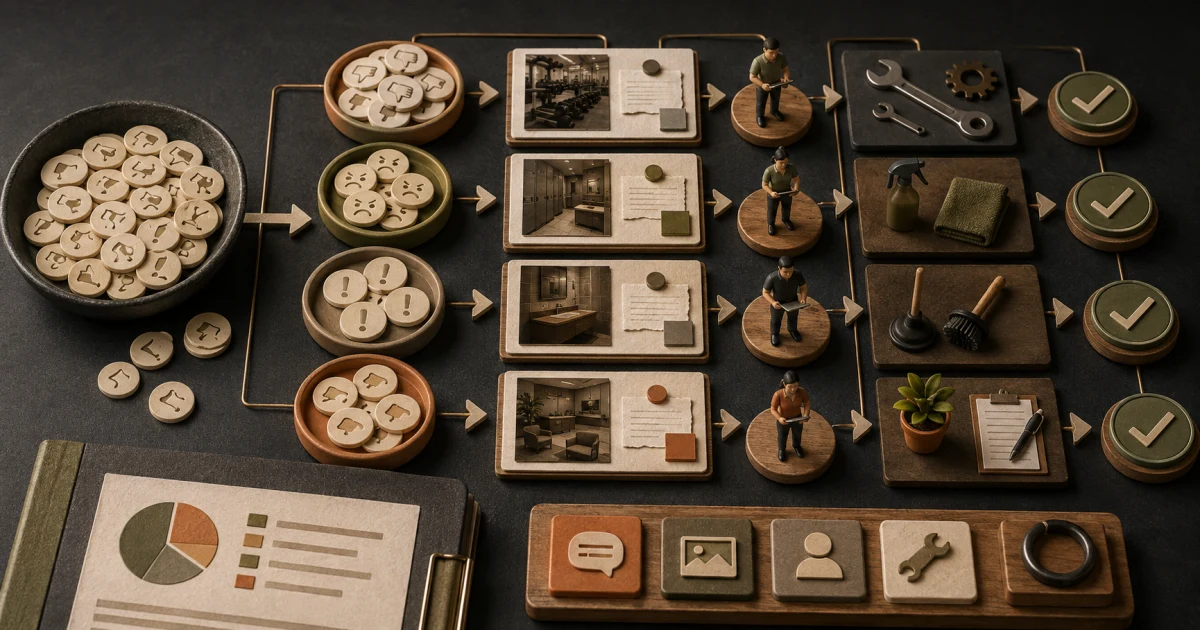

A negative review can feel personal when the gym represents years of work. The first defensive reply can create more damage than the original complaint.
Pause, preserve the review, assess safety and policy, verify what can be checked privately, then post a short reply that acknowledges the concern without exposing member information. Give a named private route, investigate the operation, and close the internal action. Report a review only when it violates policy, not merely because you disagree.
Triage before writing
| Level | Example | Public action | Internal action |
|---|---|---|---|
| 1: ordinary dissatisfaction | crowding, cleanliness, waiting, music | Acknowledge and invite details | Check logs, schedule, and floor condition |
| 2: account-specific dispute | payment, cancellation, membership status | Do not publish account facts | Route to authorised manager |
| 3: safety or conduct allegation | injury, harassment, discrimination, threats | Use calm holding response | Preserve evidence and escalate immediately |
| 4: apparent policy violation | spam, impersonation, prohibited content | Avoid argument; consider policy report | Capture evidence and use official process |
Use the full Google Business Profile checklist to assign the response owner and access controls.
Follow the six-step response method
1. Read and pause
Capture the review and time. Do not reply while angry. Identify the observable issue beneath the tone.
2. Check the public boundary
Never confirm whether the reviewer is a member. Do not disclose attendance, health, payment, cancellation, access, CCTV, staff discipline, or conversation records. Even when the reviewer publishes details, that does not authorise the gym to add more.
3. Verify privately
Look at relevant records only through authorised access. Separate:
- what the review alleges;
- what evidence confirms;
- what remains unknown;
- what requires urgent escalation.
4. Write the public response
A useful reply usually has four parts:
- acknowledge the concern;
- state the service standard without claiming facts you have not verified;
- provide a specific private contact path;
- say what will happen next.
5. Resolve in the right channel
Move the account-specific discussion to a manager-controlled channel. Give a reference, owner, and expected next update. Do not make compensation promises outside authority.
6. Close the operational loop
Record the theme, evidence, corrective action, owner, due date, and verification. Use the review operations report when the issue may repeat.
Adapt these templates, do not paste blindly
Facility issue
“Thank you for raising the concern about [general issue]. That is not the experience we want visitors to have. Our manager is checking the relevant area and schedule. Please contact [role and channel] with the date and approximate time so we can investigate and update you privately.”
Account-specific dispute
“We are sorry this has been frustrating. We cannot discuss membership or payment details in a public reply. Please contact [authorised role and channel] with your reference details so the team can review the record and explain the next step.”
Serious allegation
“We take this concern seriously. To protect everyone involved, we will not discuss personal details publicly. Please contact [senior role and channel]. The matter will be handled under our formal escalation process.”
These are frameworks, not admissions and not substitutes for legal or safety advice.
Do not use these responses
- “We have no record of you.” This can be wrong, sounds dismissive, and still invites a public identity dispute.
- “Nobody else has complained.” One complaint can still reveal a real issue.
- “Our policy is clearly written.” A policy does not prove that it was explained or applied correctly.
- “Delete the review and we will fix it.” Service recovery must not be traded for silence.
- a long point-by-point rebuttal containing private facts.
- a generic “sorry for the inconvenience” pasted under every review.
Decide whether to report
Use Google’s reporting process only when the content appears to violate a review policy. Preserve the review URL, screenshots, dates, and reason. Disagreement, harsh wording, or an inconvenient allegation is not automatically removable. Continue the internal investigation even when a report is filed.
Judge the response by the operation
A polished reply is incomplete if the broken shower remains broken, the cancellation record is still unclear, or staff never learn the result. Review the response log alongside service actions. The policy-safe request system should remain neutral even after a difficult case.
Frequently asked questions
How should a gym respond to a negative Google review?
Pause, preserve the review, assess risk, verify the issue privately, and post a concise response that acknowledges the concern without exposing member details. Provide a specific private contact route, assign an internal owner, and close the corrective action.
Should a gym admit fault in a public review reply?
Do not invent certainty. A gym can acknowledge the person’s concern and apologise for the experience without publishing unverified facts or making an unauthorised legal admission. Serious safety, conduct, or legal allegations should follow the gym’s escalation process.
Can a gym remove a negative Google review?
Only reviews that violate Google’s policies are eligible for removal through Google’s reporting process. A low rating, criticism, or disagreement with the business is not enough by itself, and removal is not guaranteed.