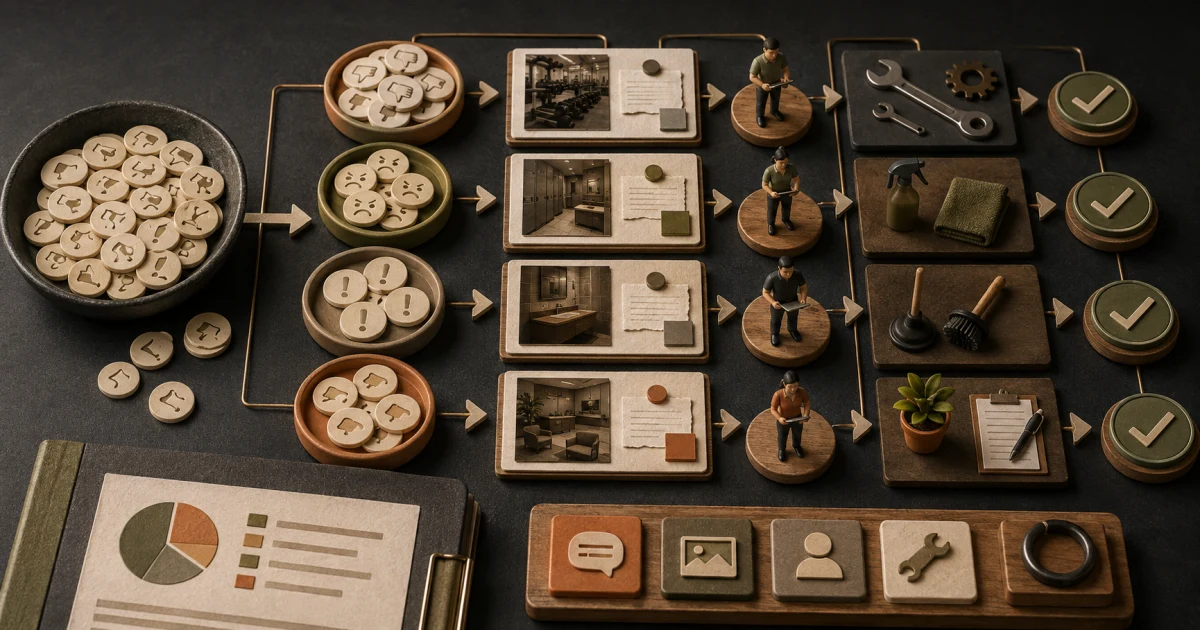
Replying to every review can create the appearance of responsiveness while the same complaint returns each month. A response closes a conversation. An operations report closes a cause.
Code reviews into consistent themes, preserve the member’s words without spreading identity, verify each material issue against operating evidence, assign corrective action with an owner and due date, and record closure proof. Treat reviews as a self-selected signal, not a representative survey of all members.
Build the review evidence table
| Field | What to record |
|---|---|
| Review reference | URL or internal ID, platform, date |
| Sentiment | Positive, mixed, negative, unclear |
| Theme | Cleanliness, equipment, crowding, staff, sales, billing, access, coaching, other |
| Stage | Discovery, enquiry, tour, joining, active use, renewal, cancellation |
| Allegation | Concise statement of what the reviewer says happened |
| Evidence status | Confirmed, partly confirmed, unconfirmed, contradicted, cannot verify |
| Severity | Routine, repeated, safety, conduct, legal or policy escalation |
| Action | Investigate, repair, clarify, train, redesign, monitor, no action with reason |
| Owner and due date | One accountable role and a real date |
| Closure proof | Photo, completed work order, revised process, training record, follow-up check |
Remove unnecessary reviewer identity from the analysis view. Restrict account-level evidence to authorised staff.
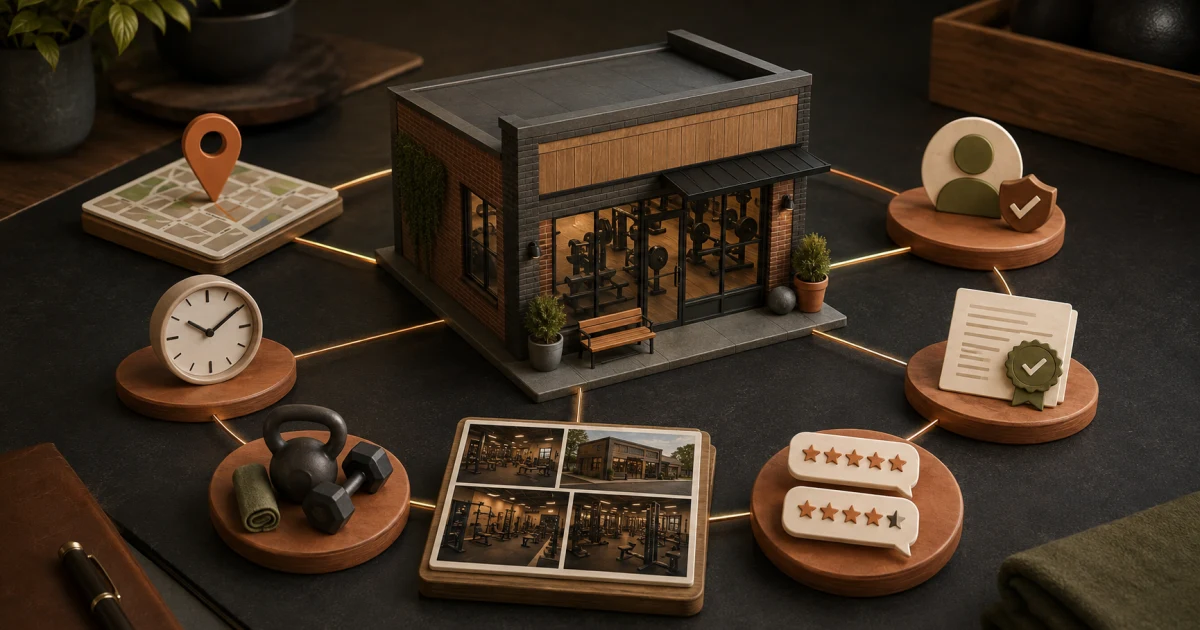
The report is one spoke of the Google Business Profile owner checklist, not a substitute for the public reply process.
Separate four kinds of information
- Allegation: what the reviewer reports.
- Verified fact: what reliable evidence confirms.
- Hypothesis: a possible cause that still needs testing.
- Action: what the gym will do, by whom, and when.
“Member says the floor is always overcrowded” is an allegation. Check-in density, class schedules, staff observation, and equipment queues may provide evidence. “We need a bigger gym” is a hypothesis until schedule, zoning, capacity, and demand are examined.
Use stable theme codes
Start with a small dictionary that staff can apply consistently:
- CLN: cleanliness and washrooms
- EQP: equipment availability or condition
- CAP: crowding, queues, temperature, or space
- STA: staff conduct and service
- SAL: sales clarity and pressure
- PAY: payments, fees, refunds, or cancellation
- ACC: opening, entry, parking, or accessibility
- COA: coaching quality and programme delivery
- POS: specific positive evidence worth protecting
Add a code only when the existing dictionary cannot represent an important repeated issue. Otherwise the report becomes too fragmented to compare.
Produce the monthly owner view
| Theme | This month | Previous period | Evidence quality | Current action | Owner | Due | Status |
|---|---|---|---|---|---|---|---|
| Strong, mixed, weak | Open, verifying, closed | ||||||
Counts alone can mislead. Five similar reviews may come from one incident, while one safety allegation may deserve immediate action. Add severity and evidence quality beside volume.
Work through a fictional example
A fictional gym receives three reviews mentioning evening equipment queues and two praising the morning floor team. Check-in data shows a sharp weekday peak, but it cannot prove individual wait times. Staff observe recurring queues at two stations.
The owner tests a revised equipment layout and a peak-hour floor rota for four weeks. Closure proof includes staff observation at fixed intervals and a comparison of queue notes. This is a fictional operating example, not an industry benchmark and not proof that the same fix suits another gym.
Protect positive evidence too
Positive reviews can reveal what the gym must not accidentally remove. Code specific praise such as clear beginner onboarding, trainer attention, equipment maintenance, or easy entry. Compare it with actual operating practices. “Friendly staff” becomes useful when the report identifies which behaviours and shifts create that experience.
Do not turn reviewer language into a marketing claim unless the use is truthful, permitted, and appropriately attributed or disclosed.
Close actions with proof
“Spoke to staff” is activity, not closure. A closed action should show:
- what changed;
- who approved it;
- when it became active;
- how staff learned the new process;
- what evidence will indicate whether it works;
- when it will be reviewed again.
Use the negative-review response guide for public communication. Keep the review-request system neutral; never suppress requests merely because an unresolved theme exists.
Avoid false conclusions
- Reviewers are self-selected and may not represent the membership.
- Star averages can hide specific operational issues.
- A public allegation is not automatically a verified fact.
- A missing complaint does not prove a problem is absent.
- A change in review volume may reflect request activity, season, or platform behaviour.
- Correlation between an action and later reviews does not prove causation.
Combine reviews with staff observations, maintenance logs, enquiries, attendance patterns, cancellations, and direct member research under privacy-safe controls.
Frequently asked questions
How can a gym use reviews to improve operations?
Code reviews into stable themes, separate allegations from verified facts, compare patterns over time, assign each material issue to an owner, set a due date, and retain evidence that the corrective action was completed and checked.
Are online reviews representative of all gym members?
Not necessarily. Reviewers are self-selected, and request patterns or unusual incidents can influence who posts. Treat reviews as one important signal and compare them with operational records, direct research, staff observations, and member outcomes.
What should a gym review report include?
Include the review reference, date, sentiment, theme, journey stage, allegation, evidence status, severity, action, owner, due date, status, and closure proof. Keep personal and account-specific details in restricted systems rather than the general report.