A new enquiry arrives at 7:04 p.m. The front desk assumes the sales manager saw it. The sales manager assumes the evening shift replied. By morning, the lead exists in three inboxes and belongs to nobody.
A gym lead-response SLA should define which enquiries count, the first-response target for each staffed period and channel, the named owner, a fallback owner, the required log, and the escalation when the target is missed. Measure your own response distribution and conversion before adopting an internet benchmark.
This guide treats lead handling as an operating system, not a collection of persuasive tricks. The core owner question is: Can every staff member answer: “Who owns this enquiry now, when is the next action due, and where is the evidence?”
Place this decision inside the Cluster E system
The ten guides separate failures that are often blended into one conversion number:
Start with the lead-response SLA, then use the missed-call recovery system, WhatsApp enquiry playbook, and pipeline forecast where their decisions apply. A strong result in one stage cannot repair bad data or a broken handoff in another.
Define the record before measuring it
| Term | Working definition |
|---|---|
| Received time | The first trustworthy system timestamp, preserved in one timezone. |
| Meaningful first response | A relevant human or clearly labelled automated acknowledgement that sets a useful next step. |
| Owned | One named role accepts responsibility. A shared inbox is a location, not an owner. |
| SLA clock | The measured interval with stated staffed-hours, channel, pause, and exception rules. |
| Breach | A due action that passed its target, including a reason and recovery owner. |
Write these definitions into the operating checklist. Otherwise one staff member will count a message as contact, another will require a call, and the monthly chart will compare different events under the same name.
Run the workflow with a named owner
| Step | Required action | Accountable role |
|---|---|---|
| Capture | Create one lead record and preserve source, consent context, channel, and received time. | Front desk on duty |
| Assign | Route by channel and staffed period to one primary owner. | Shift lead |
| Acknowledge | Confirm the enquiry and propose a useful next action without pretending automation is human. | Assigned owner |
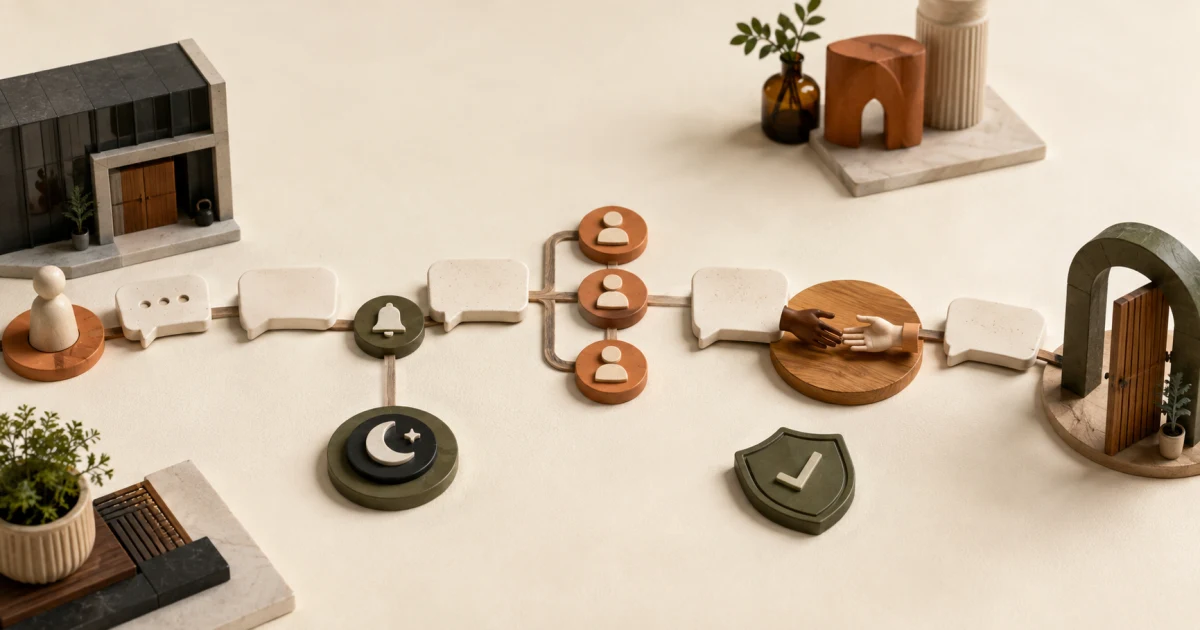
| Escalate | If unaccepted or overdue, move it to the fallback queue and alert a named role. | Duty manager |
| Close the loop | Record contact, outcome, next due action, and loss reason where applicable. | Current owner |
The owner column cannot say “team.” Several people may contribute, but only one role should be accountable for the next due action. If responsibility changes at a shift handover, the new owner must accept it rather than inherit an invisible queue.
Copy this SLA register
| Channel and staffed period | Target to acknowledgement | Target to human action | Primary owner | Fallback | Breach reason |
|---|---|---|---|---|---|
| Website form, staffed | |||||
| Phone missed during staffed hours | |||||
| WhatsApp inbound, staffed | |||||
| After-hours enquiry | |||||
| Walk-in requiring follow-up |
Blank cells are intentional. Fill them from the gym’s actual offer, hours, capacity, policies, and records. A copied industry number can be a question to investigate, but it is not a local operating standard.
Work through a fictional example
A fictional gym logs 84 enquiries in four weeks. The median human response is 18 minutes, but the 90th percentile is 11 hours because evening WhatsApp enquiries are not assigned. Instead of declaring an arbitrary five-minute target, the owner creates an immediate acknowledgement, a 30-minute staffed-hours acceptance target, an opening-shift queue for after-hours enquiries, and a 45-minute breach alert. The next review compares response distributions, contact rate, booked visits, and paid joins by channel.
The example is deliberately fictional and is not an industry benchmark. Its purpose is to show the calculation or control path. Replace every assumption with an observed record from your gym and preserve the source period.
Measure the whole outcome, not the easiest event
Track:
- Median and 90th-percentile time to human action by channel and staffed period
- Percentage accepted by an owner before the target
- Contact, visit-booked, visit-attended, and paid-join rates by response band
- Breach count and controlled reason
- Duplicate contacts, opt-outs, and complaints
Use consistent denominators. A contact rate, an attended-visit rate, and a paid-join rate answer different questions. Keep source, staffed period, offer, and sample size visible before comparing teams or weeks.
Protect the prospect and the quality of the decision
- Do not call an automated acknowledgement a completed human response.
- Do not pause the clock silently when staffing is inconvenient.
- Do not expose health goals or enquiry details in shared notifications.
- Do not reward speed alone if the reply is irrelevant or pressuring.
- Do not claim faster response caused a membership without a controlled test.
Fitness enquiries can reveal sensitive context even when a person never writes a diagnosis. Collect the minimum needed for the current decision, restrict access, define retention, and move exercise or medical screening into a separate qualified process when it is genuinely required.
Implement this in one operating week
- Map every enquiry channel and its real staffed hours.
- Choose a primary and fallback role for each row.
- Run one baseline week before setting targets.
- Train one acknowledgement and one handoff standard.
- Review breaches weekly, then change targets only with evidence.
At the weekly review, inspect a small sample of the underlying calls, messages, visit records, stage timestamps, and collections. A tidy dashboard cannot compensate for ambiguous events or invented reasons.
Frequently asked questions
How fast should a gym respond to a lead?
There is no universal number for every gym and channel. Measure your current response distribution, prospect availability, staffed hours, contact and conversion outcomes, then set a demanding but achievable target with a fallback and breach process.
Does an automatic WhatsApp reply meet the SLA?
It can meet a clearly labelled acknowledgement target if it confirms receipt and sets an honest expectation. It should not be counted as the completed human response when a person still needs to understand or act on the enquiry.
Who should own gym leads?
One named role should own each lead at any moment, with a fallback for absence or overload. Ownership can change across a handoff, but the next owner must accept it and the system must preserve who is responsible.