A packed event can produce great photographs and still fail as a retention programme if the same highly engaged members attend every time and staff time, disruption, and exclusions are ignored.
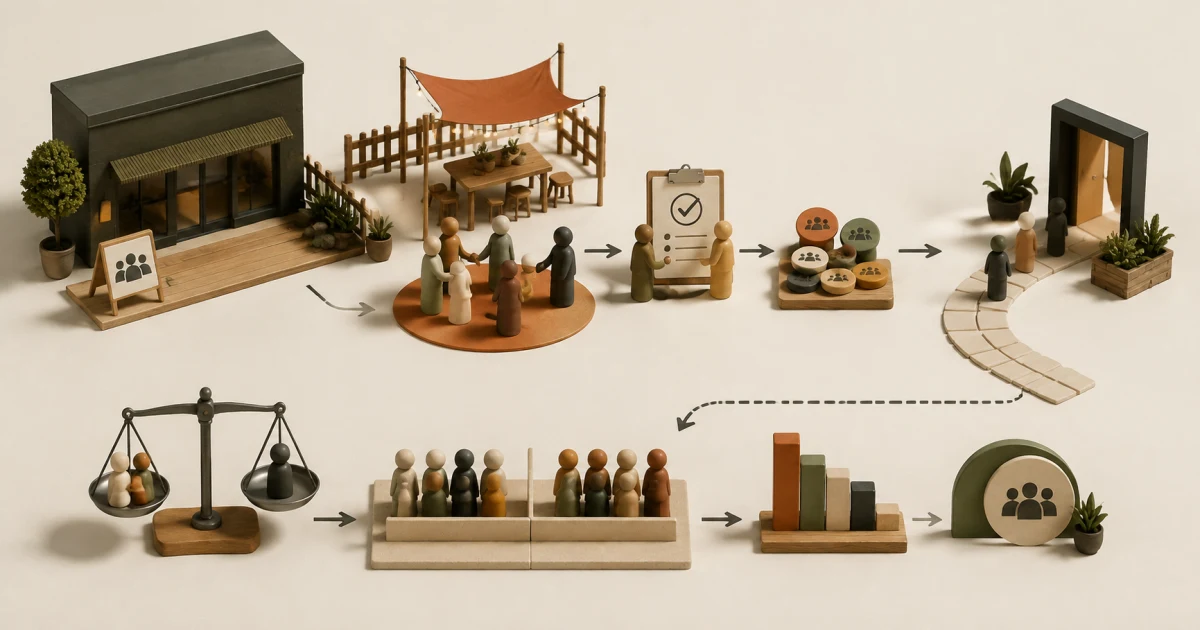
Evaluate a gym community event by stating the member problem and hypothesis, defining eligible groups, recording full cost and attendance, collecting experience feedback, observing later behaviour at equal windows, and documenting selection bias. Use a pilot, not a retention promise.
The owner decision is: Did this event create enough member value to justify its cost and operational tradeoffs, and what can the data actually support? This guide does not prescribe a universal benchmark. It gives the gym a record, calculation, or control it can test against its own people, service model, capacity, and evidence.
Use the Collection G roadmap
Retention, Re-engagement, and Community is a ten-decision operating sequence. Each page owns a different question and original asset:
| Order | Guide | Working asset |
|---|---|---|
| 1 | How to Calculate Gym Retention and Churn Correctly | Member, revenue, and cohort retention worksheet |
| 2 | Attendance Decay: Spot At-Risk Gym Members Earlier | Personal-baseline 7/14/30-day intervention grid |
| 3 | Map the End-to-End Gym Member Journey and Find Friction | Evidence-led member journey map |
| 4 | Gym Cancellation Interviews: Questions That Produce Useful Answers | Neutral cancellation interview and theme register |
| 5 | Voluntary vs Involuntary Gym Churn: Report Them Separately | Voluntary and involuntary churn bridge |
| 6 | Which Gym Marketing Channels Bring Members Who Stay? | Acquisition-source cohort quality table |
| 7 | Gym Win-Back Campaigns: Segment Former Members First | Former-member contact decision tree |
| 8 | Build a Gym Member Milestone System Without Embarrassment | Consent-aware milestone recognition matrix |
| 9 | Build a Gym Member Feedback System That Produces Action | Feedback register from signal to closure |
| 10 | Do Gym Community Events Improve Retention? Test It | Community-event evaluation sheet |
Use the collection pillar for the full sequence. The related feedback system, retention calculation, milestone system go deeper where this decision hands work to another process.
Define the record before interpreting it
| Term | Working definition |
|---|---|
| Hypothesis | The specific member experience or behaviour expected to change. |
| Eligible group | Members who could reasonably participate. |
| Participant | A person with verified attendance under the event rule. |
| Full cost | Cash, staff time, space, disruption, communication, and opportunity cost. |
| Comparison | A cautious reference group or pre-period, not automatic causal proof. |
Keep the definition visible beside the data. If staff change a threshold, denominator, or evidence rule, record the effective date. A chart that quietly changes meaning is worse than a blank chart because it gives false confidence.
Run the operating sequence
| Step | What must happen | Accountable role |
|---|---|---|
| Design | State problem, audience, hypothesis, capacity, access, cost, and success evidence. | Event owner |
| Invite | Use relevant communication and accessible participation choices. | Community owner |
| Deliver | Record attendance, experience, incidents, and operational impact. | Event team |
| Compare | Observe participant and eligible nonparticipant outcomes with caveats. | Analyst |
| Decide | Repeat, adapt, stop, or test again based on value and harm. | Owner |
“Team” is not an accountable role. Several people can contribute, but one role must own the next action, exception, and closure. At a handoff, the receiving role acknowledges the open item so responsibility does not vanish between shifts.
Community-event evaluation sheet
| Event input | Plan | Actual | Evidence source | Decision |
|---|---|---|---|---|
| Eligible members | ||||
| Participants and representation | ||||
| Cash and staff cost | ||||
| Experience and issues | ||||
| Later attendance or status |
Fill the blank cells from the gym’s actual records. Where a field needs professional review, name the reviewer and record the version. Do not turn a worksheet into a medical, legal, accounting, employment, or exercise prescription.
Work through a fictional example
A fictional Saturday workshop costs ₹18,000 including staff time and displaces a paid class. Forty of 300 eligible members attend, mostly already frequent users. Feedback is strong and 12 bring a friend, but retention comparison is inconclusive. The owner calls it a successful experience pilot, not proof of reduced churn.
This example is fictional and is not an industry benchmark. It shows how the method behaves, including uncertainty. Replace it with a local sample and keep the source period, exclusions, and unresolved data visible.
Stress-test the operating rule before scaling it
Run the tool against three cases: a normal record, a legitimate exception, and a failure. For the normal case, confirm that staff can complete the process without private side messages or owner memory. For the exception, identify who has authority, what evidence is required, how the decision is recorded, and when it expires. For the failure, test what happens when a person is absent, a payment or device is wrong, a record is duplicated, the member disagrees, or the next shift receives incomplete information.
Then inspect the blast radius. Ask which member, prospect, staff role, report, message, collection, and later decision will read the result. A field that looks harmless in one screen can become a misleading KPI or an unnecessary privacy disclosure elsewhere. Keep a correction path so an authorized person can fix bad data without deleting the original event or inventing a cleaner history.
Finally, define the stop condition. A process should pause when required evidence is missing, competent review is unavailable, member safety or privacy is uncertain, or the proposed action exceeds the authority of the current role. Escalation is part of a complete system, not evidence that the system failed.
Measure whether the decision improved
Track the following as a connected set:
- Eligible, invited, registered, attended, and represented groups
- Cash, staff, space, disruption, and opportunity cost
- Member experience, accessibility, incidents, and complaints
- Later attendance and status at equal windows with baseline differences
- Referrals, revenue, and contribution where relevant
Compare like with like. Show cohort, time window, sample size, source, and operational change where they matter. A movement after an intervention is a signal to investigate, not automatic causal proof.
Protect the member, prospect, and team
- Do not require public participation to prove belonging.
- Do not expose attendance or images without permission.
- Do not exclude members through inaccessible timing without reporting it.
- Do not attribute retention to the event from participant correlation.
- Do not ignore displaced classes and staff load.
Gym records can expose routines, health context, financial difficulty, staff performance, and personal relationships. Collect the minimum needed for the stated decision, restrict access, define retention, and keep sensitive notes out of broad dashboards and handovers.
Put it into operation this week
- Write one testable event hypothesis.
- Define eligibility and full cost.
- Run a bounded pilot.
- Collect experience and operational evidence.
- Decide what the result supports and what remains unknown.
At the review, inspect underlying records rather than accepting the summary alone. Keep “unknown” as a valid state, assign one corrective action, and decide when the next audit will show whether it worked.
Frequently asked questions
Can community events improve gym retention?
They may improve connection or experience for some members, but local selection, service, cost, and later behaviour need measurement. Participation alone does not prove retention impact.
What should a gym event measure?
Measure eligibility, registration, attendance, representation, member experience, accessibility, incidents, full cost, later behaviour, referrals, and contribution where relevant.
How can a gym test event impact fairly?
State the hypothesis first, compare equal observation windows, document baseline differences and confounders, and use the result as evidence for the next test rather than causal certainty.