
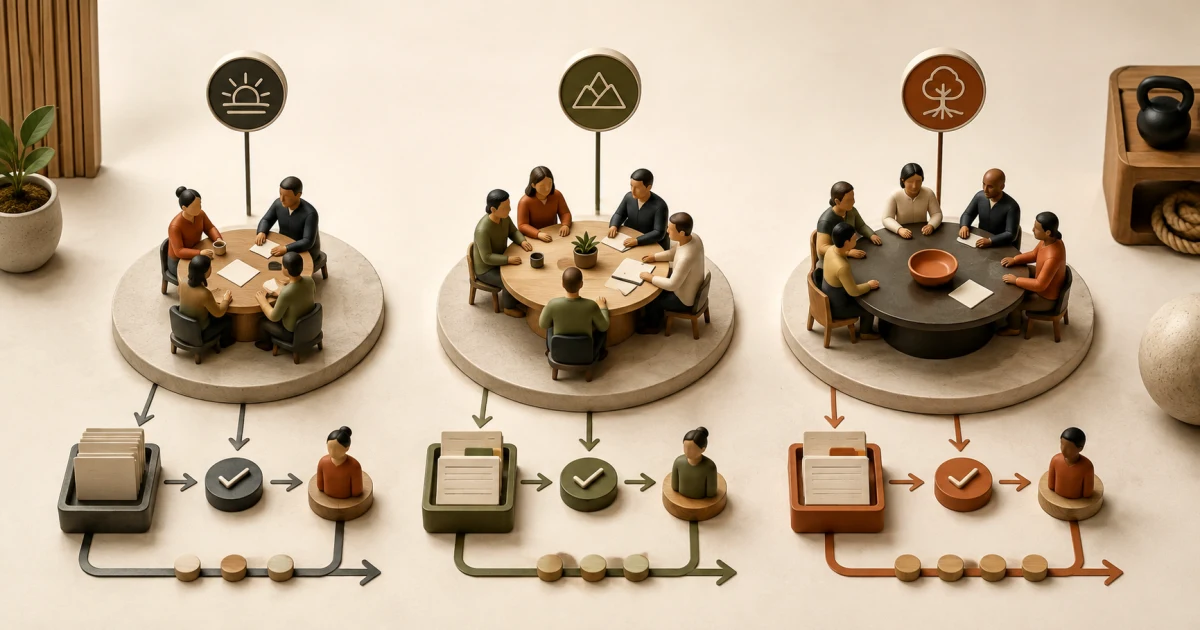
Twelve people spend an hour reading numbers they could have reviewed before the meeting. Everyone leaves informed, but no decision has an owner, due date, or evidence of closure.
Use a short daily operations check, a weekly decision meeting, and a monthly system review only where the gym’s complexity requires them. Price the staff time and preserve action closure.
The owner decision is: Which decisions need this group at this frequency, and what would fail without the meeting? This guide does not prescribe a universal benchmark. It gives the gym a record, calculation, or control it can test against its own people, service model, capacity, and evidence.
Use the Collection I roadmap
Team Systems and Owner Independence is a ten-decision operating sequence. Each page owns a different question and original asset:
| Order | Guide | Working asset |
|---|---|---|
| 1 | The Gym Owner Bottleneck Audit: What Stops When You Leave? | Owner-dependence risk and delegation map |
| 2 | A Front-Desk Daily Checklist for Gyms | Opening, peak, and closing control sheet |
| 3 | Gym Shift Handover: What the Next Team Needs | Minimum safe shift-handover record |
| 4 | Design Gym Sales Incentives Without Bad-Fit Memberships | Compensation outcome simulation |
| 5 | Gym Trainer Utilization Without Treating People Like Machines | Fair trainer capacity and utilization dashboard |
| 6 | How to Build a Gym SOP Library Staff Will Use | Versioned SOP template and index |
| 7 | The Weekly Gym Owner Scorecard: 12 Decision Numbers | Twelve-metric owner decision sheet |
| 8 | A Practical Meeting Cadence for Gym Teams | Daily, weekly, and monthly meeting cards |
| 9 | Gym Payroll-to-Revenue Ratio Without Reckless Cuts | Payroll ratio scope and scenario bridge |
| 10 | Gym CRM Data Hygiene: A Safe Cleanup Runbook | CRM cleanup and prevention runbook |
Use the collection pillar for the full sequence. The related weekly scorecard, shift handover, owner bottleneck go deeper where this decision hands work to another process.
Define the record before interpreting it
| Term | Working definition |
|---|---|
| Trigger | The observable event that starts this process. |
| Evidence | The minimum trustworthy record needed for a decision. |
| Owner | The one role accountable for the next action and closure. |
| Exception | A non-standard case with authority, reason, evidence, and expiry. |
| Outcome | The completed state used for review, not merely an activity. |
Keep the definition visible beside the data. If staff change a threshold, denominator, or evidence rule, record the effective date. A chart that quietly changes meaning is worse than a blank chart because it gives false confidence.
Run the operating sequence
| Step | What must happen | Accountable role |
|---|---|---|
| Define | Write trigger, evidence, decision, owner, due time, exception, and outcome. | Process owner |
| Observe | Collect the minimum source records and preserve unknowns. | Assigned role |
| Decide | Apply the rule within documented authority. | Decision owner |
| Escalate | Pause and route missing evidence, risk, conflict, or out-of-scope work. | Duty manager |
| Review | Sample source records, outcomes, harm, and unintended behaviour. | Owner |
“Team” is not an accountable role. Several people can contribute, but one role must own the next action, exception, and closure. At a handoff, the receiving role acknowledges the open item so responsibility does not vanish between shifts.
Daily, weekly, and monthly meeting cards
| Area | Current state | Required standard | Owner and evidence | Failure or exception |
|---|---|---|---|---|
| Daily: immediate operations | ||||
| Weekly: cross-team decisions | ||||
| Monthly: system and financial review | ||||
| Preparation and pre-read | ||||
| Actions and closure |
Fill the blank cells from the gym’s actual records. Where a field needs professional review, name the reviewer and record the version. Do not turn a worksheet into a medical, legal, accounting, employment, or exercise prescription.
Work through a fictional example
A fictional 12-person gym spends 19 staff-hours weekly across meetings. Removing status rounds, moving facts to a pre-read, and keeping three decision questions reduces the cost to nine hours with better action closure.
This example is fictional and is not an industry benchmark. It shows how the method behaves, including uncertainty. Replace it with a local sample and keep the source period, exclusions, and unresolved data visible.
Stress-test the operating rule before scaling it
Run the tool against three cases: a normal record, a legitimate exception, and a failure. For the normal case, confirm that staff can complete the process without private side messages or owner memory. For the exception, identify who has authority, what evidence is required, how the decision is recorded, and when it expires. For the failure, test what happens when a person is absent, a payment or device is wrong, a record is duplicated, the member disagrees, or the next shift receives incomplete information.
Then inspect the blast radius. Ask which member, prospect, staff role, report, message, collection, and later decision will read the result. A field that looks harmless in one screen can become a misleading KPI or an unnecessary privacy disclosure elsewhere. Keep a correction path so an authorized person can fix bad data without deleting the original event or inventing a cleaner history.
Finally, define the stop condition. A process should pause when required evidence is missing, competent review is unavailable, member safety or privacy is uncertain, or the proposed action exceeds the authority of the current role. Escalation is part of a complete system, not evidence that the system failed.
Measure whether the decision improved
Track the following as a connected set:
- Completion and outcome under one stable definition
- Time from trigger to accepted ownership and closure
- Exceptions, overrides, corrections, and overdue actions
- Member or team impact, complaints, and repeated failure
- Cost, capacity, and downstream metric distortion
Compare like with like. Show cohort, time window, sample size, source, and operational change where they matter. A movement after an intervention is a signal to investigate, not automatic causal proof.
Protect the member, prospect, and team
- Do not use “team” where one accountable role is required.
- Do not place sensitive member or staff detail in broad reports.
- Do not reward a metric that can improve by harming fit or quality.
- Do not let an exception become an undocumented permanent rule.
- Do not delete the evidence needed to understand a correction.
Gym records can expose routines, health context, financial difficulty, staff performance, and personal relationships. Collect the minimum needed for the stated decision, restrict access, define retention, and keep sensitive notes out of broad dashboards and handovers.
Put it into operation this week
- Map one normal case from trigger to closure.
- Write decision rights and the exception path.
- Test one shift change or absence.
- Reconcile a sample against source records.
- Assign one improvement and a re-audit date.
At the review, inspect underlying records rather than accepting the summary alone. Keep “unknown” as a valid state, assign one corrective action, and decide when the next audit will show whether it worked.
Frequently asked questions
What meetings should a gym team have?
Use only the daily, weekly, and monthly forums needed for immediate coordination, cross-team decisions, and system review.
How long should gym meetings be?
Set time from the decisions and preparation required, not a universal duration. End when decisions, owners, and due dates are clear.
How do you calculate meeting cost?
Add attendee paid time, preparation, coverage, disruption, and opportunity cost, then compare with decisions and failures prevented.