
A membership expires on the 30th. The owner notices on the 4th of the following month, when the member does not turn up. A message goes out. It is polite, and it is far too late.
The uncomfortable truth about renewals is that they are rarely lost on the expiry date. They are lost several weeks earlier, quietly, and the expiry date is just when the loss becomes visible.
The decision happens before the deadline
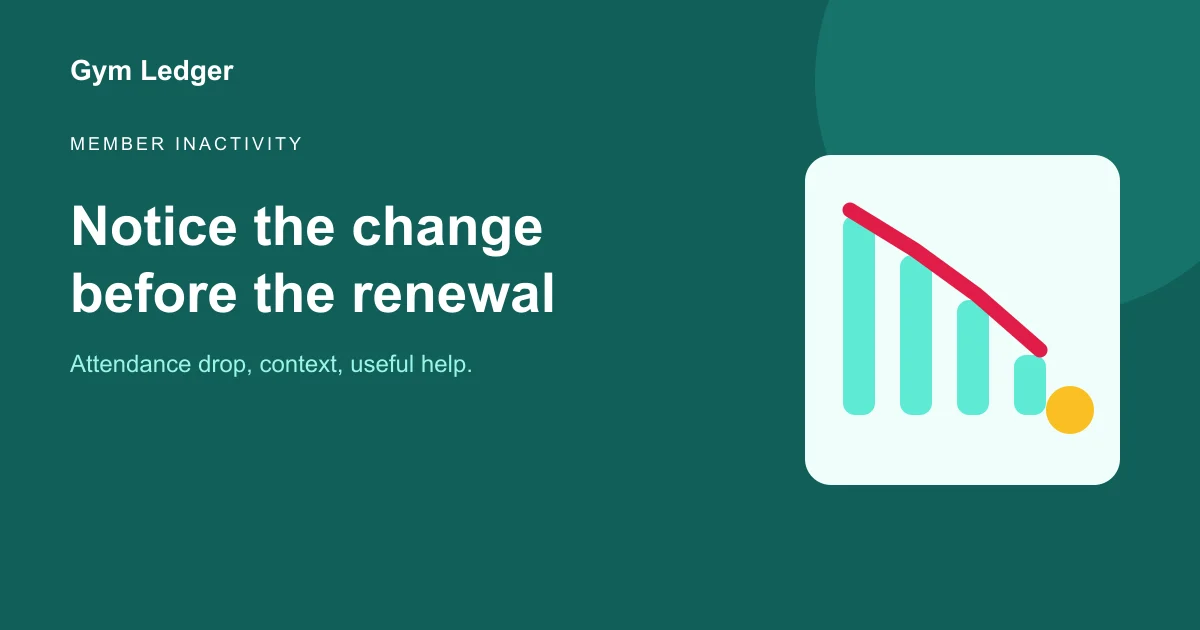
Watch the pattern closely and it is remarkably consistent. A member trains four times a week for two months. Then it drops to twice. Then once. Then a fortnight passes with no visit. Then the plan expires and nobody is surprised except the gym.
By the time the expiry arrives, the member has already stopped thinking of themselves as someone who goes to your gym. Asking them to renew is asking them to restart a habit they have already dropped, which is a much harder ask than continuing one.
This is why renewal rate is really an attendance problem wearing a billing costume.
Two lists your gym should be able to produce instantly
The expiry list. Everyone whose membership ends in the next seven to fourteen days. This is your warm list. They are still coming in, the habit is intact, and the conversation is easy because you are catching them before anything lapses.
The absence list. Everyone who has not checked in for two weeks or more but whose membership is still active. This is your urgent list, and it is the one almost no gym has, because producing it requires attendance data nobody collected.
A member on the absence list is worth more attention than a member on the expiry list. The expiry is a scheduling problem. The absence is a signal that you are about to lose someone who is still paying you.
Why the reminder has to be automatic
Every gym owner intends to check both lists. Almost none do it consistently, and not because they are careless. It is because remembering to check is itself work, and it competes with a floor full of people who need attention right now.
The only version of this that survives contact with a real week is one where the list arrives without being asked for. Gym Ledger sends a daily summary of memberships expiring soon and balances still pending, and surfaces members with no recent visit on the dashboard. Nobody has to remember to look.
That is a small mechanical difference with a large commercial effect. A reminder you have to trigger is a reminder that happens in quiet weeks and not in busy ones, which is exactly backwards.
What to actually say
Timing matters more than wording, but wording still matters. Three things tend to work better than a generic renewal notice:
- Reference their actual training. “You have been in eleven times this month” is a different message from “your plan expires soon”. One acknowledges a person, the other processes an account.
- Ask before it lapses, not after. Continuing is easier than restarting, for the member as much as for you.
- Make the absence conversation a check-in, not a sales call. Someone who has not come for three weeks usually has a reason. Sometimes it is an injury, sometimes a work schedule, occasionally a freeze would solve it entirely. A membership freeze keeps them as a member instead of turning them into a lapsed one.
Freeze instead of losing them
That last point deserves its own line. When a member travels for a month or picks up an injury, the choice is not always renew or leave. Pausing the membership and resuming it later keeps the relationship intact, and it is a far better outcome than a cancellation you find out about six weeks later.
If pausing a membership is difficult in your system, people will cancel instead, because cancelling is easy.
The scoreboard
Renewals improve when three things are true: you know who is expiring, you know who has gone quiet, and both lists reach you without being requested. Everything else is conversation.
Gym Ledger tracks membership status, surfaces members at risk from attendance, sends the daily summary, and lets you freeze and resume a plan without recalculating dates by hand.
See the plans and stop finding out about lapsed members after they lapse.