 India
 Australia
 Bangladesh
 Brazil
 Canada
 Egypt
 Germany
 Indonesia
 Kenya
 Lebanon
 Malaysia
 Mexico
 Nepal
 Nigeria
 Pakistan
 Philippines
 Saudi Arabia
 Singapore
 South Africa
 Sri Lanka
 Thailand
 UAE
 United Kingdom
 United States
 Vietnam
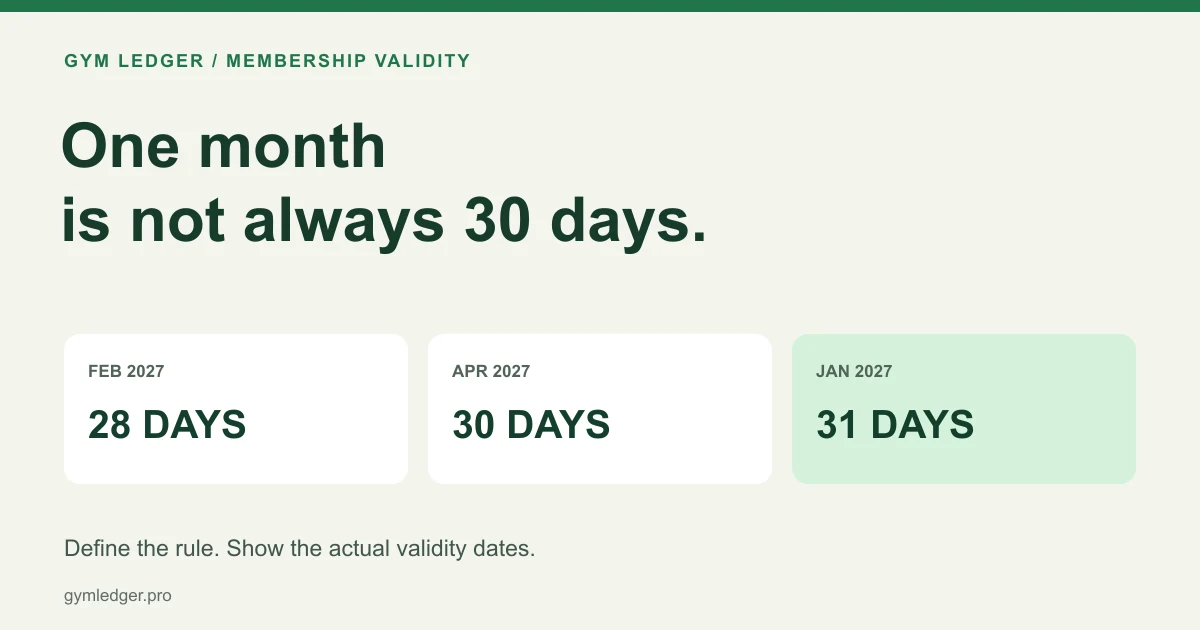
“Monthly” can hide several different promises: 30 days from joining, access until the end of a calendar month, or access until the next monthly anniversary. A member and receptionist can both think they understood the offer and still expect different expiry dates.
A 30-day gym membership has a fixed number of days. A calendar-month membership follows a defined monthly boundary, so its day count can vary. Publish the rule and show the first and last valid dates before taking payment. A recurring payment frequency is another field; it does not, by itself, define the access period or the contract commitment.
This is a guide to date definitions. For the commercial choice between plan lengths, see monthly, quarterly and annual gym plans.
Name the period you actually sell
Choose language that staff can apply consistently.
| Period type | Example definition | Decision that still needs to be stated |
|---|---|---|
| Fixed 30 days | Thirty consecutive gym-local calendar dates, including the start date | Whether access covers the whole last date or ends at a specific time |
| Whole calendar month | From the first day of a named month through its last day | How someone joining mid-month is charged and when their first period begins |
| Monthly anniversary | From an agreed start boundary until the next monthly boundary | What happens when the next month lacks the same date |
These are possible definitions, not a universal legal standard for gym contracts. The written offer, applicable requirements and the membership record need to agree. Avoid a headline that says “one month” while a receipt quietly says “30 days.”
Compare dates before comparing prices
The following examples use whole-day access and include the start date. A calendar-month plan begins on the first day of the month in each row.
| Start date | Last valid day for 30 days | Last valid day for that calendar month | Days in that month |
|---|---|---|---|
| 1 January 2027 | 30 January 2027 | 31 January 2027 | 31 |
| 1 February 2027 | 2 March 2027 | 28 February 2027 | 28 |
| 1 April 2027 | 30 April 2027 | 30 April 2027 | 30 |
| 1 February 2028 | 1 March 2028 | 29 February 2028 | 29 |
The periods match in April and differ in the other examples. Neither duration is inherently wrong. The problem is promising one and saving the other.
Under the fixed-day convention used here:
last valid date = start date + (number of days - 1)
next continuous start date = last valid date + 1 day
The subtraction accounts for the start date already being day one. This formula describes calendar dates; it is not an instruction to substitute a fixed number of seconds for timezone-aware date handling.
Decide what an expiry date means
Two systems can display 30 November and mean different things. One may allow access throughout 30 November. Another may store an exclusive cutoff at the beginning of that date.
Write “valid through 30 November” when the day is included. If access ends at a particular time, state the time and the gym’s timezone. Ensure the staff view, member confirmation and any supported door-access system interpret the boundary consistently.
For reporting, distinguish the last included date from the first inactive date. Otherwise a report generated in the morning can label someone expired while reception expects their final paid day to remain available.
Handle the 29th, 30th and 31st explicitly
An anniversary-based membership starting on 31 January cannot use 31 February as its next boundary. The gym needs a documented rule rather than a receptionist’s best guess.
One possible rule clamps the next boundary to the last date of a shorter month. Under a start-inclusive, next-boundary-exclusive convention, a boundary of 28 February means the previous period’s last included date is 27 February. Another policy may include 28 February and use 1 March as the next boundary. Those policies provide different access and must not be treated as interchangeable.
Also decide whether later renewals return to the original anchor date. A system that repeatedly adds a month to an already shortened date can behave differently from one that preserves the original anchor. Test the January-to-February and February-to-March transitions together.
You do not need to describe date algorithms in an advertisement. You do need one agreed rule behind the dates staff show a member.
Use a short plan-definition record
Keep this information with the plan setup and staff instructions.
| Field | Example for a fixed-day plan |
|---|---|
| Public plan name | 30-Day Gym Access |
| Duration rule | 30 consecutive local calendar dates |
| Start date included | Yes |
| Last valid date included | Yes, during normal opening hours |
| Early renewal | Next period starts after the current last valid date |
| Freeze treatment | Apply the separately agreed freeze policy |
| Payment frequency | Paid once for this period |
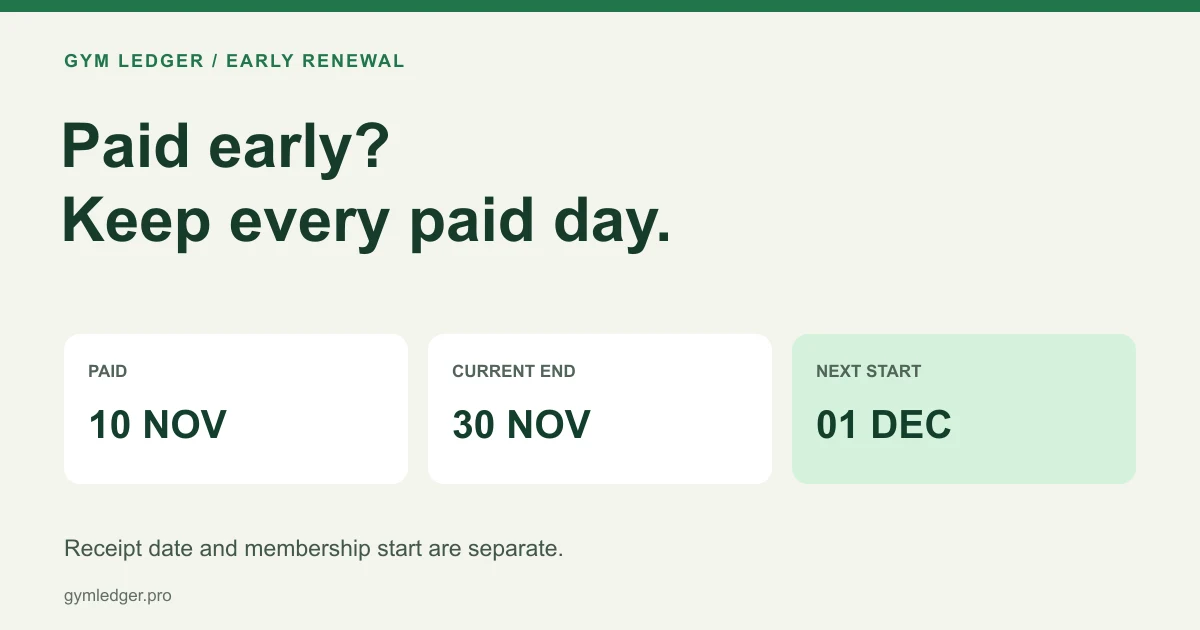
Use the early renewal date guide when a member pays before the current period ends. Do not reset their duration to the receipt date merely because payment arrived early.
Test the saved dates before selling the plan
Try a normal month, February, a leap year, a month-end start and an early renewal in the software’s supported test environment. Record the expected start and last valid date, save the case and read it back.
Check the same case in the member-facing confirmation. A correct owner screen does not resolve a receipt that displays a different end date. If a vendor’s date convention differs from your intended offer, resolve that before selling the plan rather than relying on staff to correct every transaction later.
Frequently asked questions
Is a monthly gym membership always 30 days?
No. A plan may use a fixed 30-day duration, a named calendar month or a monthly anniversary rule. The gym should state which rule applies and show the actual validity dates.
How do I calculate the last day of a 30-day gym plan?
If the start date counts as day one and the last date is included, add 29 calendar days to the start date. A plan starting on 1 February 2027 would then remain valid through 2 March 2027.
Should access remain valid on the expiry date?
That depends on the agreed boundary convention. State whether the displayed expiry date is the last included day or the first inactive day, and keep all member and staff views consistent.
What should happen to a monthly membership starting on the 31st?
Define the shorter-month rule and whether later periods return to the original anchor date. Test the saved dates across February and March instead of assuming every system calculates them identically.