A punishing first session can look impressive to a coach and make the member dread returning. Soreness is not proof that the onboarding worked.
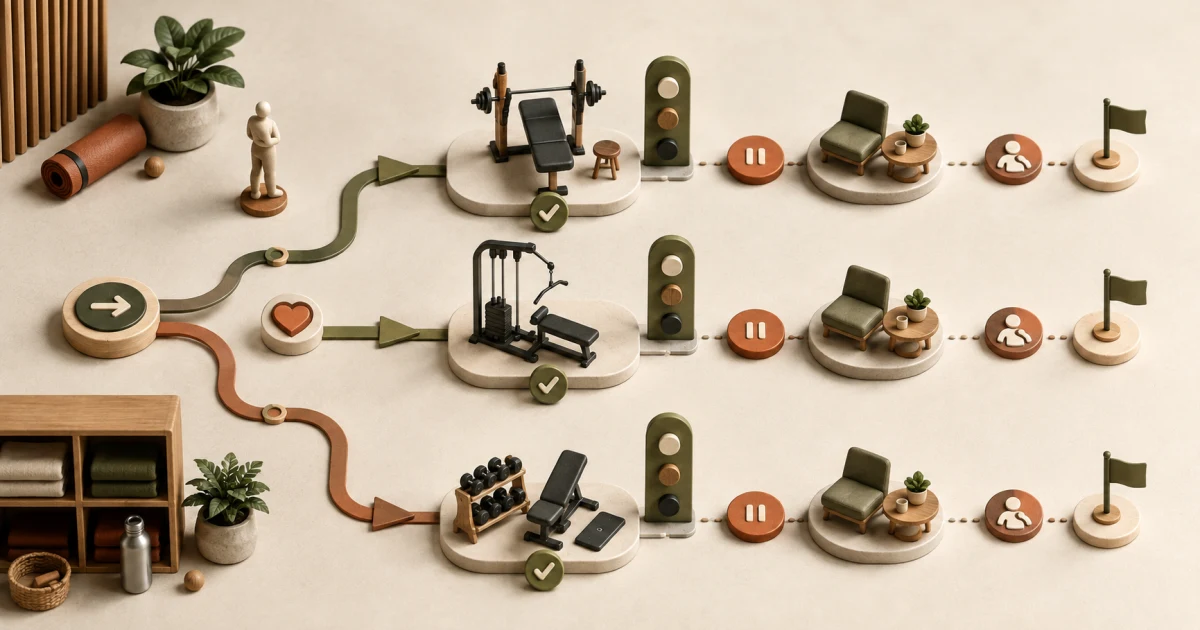
Design the first workout around the qualified coach’s assessment, clear purpose, a manageable set of activities, equipment confidence, appropriate effort and supervision, a short debrief, and an agreed next visit. Prioritize understanding and return readiness over spectacle.
The owner decision is: Did the member leave understanding what they did, how support works, and why returning feels possible? This guide does not prescribe a universal benchmark. It gives the gym a record, calculation, or control it can test against its own people, service model, capacity, and evidence.
Use the Collection F roadmap
Onboarding and the First 90 Days is a ten-decision operating sequence. Each page owns a different question and original asset:
| Order | Guide | Working asset |
|---|---|---|
| 1 | How to Reduce First-Visit Anxiety for New Gym Members | First-visit uncertainty map |
| 2 | A New Gym Member First-Day Checklist for Owners and Staff | Member and staff first-day checklists |
| 3 | The Seven-Day Activation Metric for New Gym Members | Seven-day activation rule and exception sheet |
| 4 | A 30-Day New-Member Touchpoint Calendar Staff Can Follow | Attendance-responsive 30-day contact calendar |
| 5 | Capture New Gym Member Goals Without Unsafe Promises | Goal record with claim and escalation boundaries |
| 6 | Sales-to-Trainer Handoff: Stop Repeating the Member Story | Minimum viable handoff record |
| 7 | Beginner Gym Orientation: What to Teach Before Solo Training | Beginner orientation competency checklist |
| 8 | Design a First Gym Workout That Builds Confidence | First-workout experience debrief |
| 9 | How to Audit Where Your Gym Onboarding Process Fails | Join-to-90-day failure map |
| 10 | The First-90-Day Gym Member Cohort Dashboard | First-90-day cohort dashboard specification |
Use the collection pillar for the full sequence. The related beginner orientation, goal capture guide, 30-day calendar go deeper where this decision hands work to another process.
Define the record before interpreting it
| Term | Working definition |
|---|---|
| Session purpose | The specific experience or learning objective for the first workout. |
| Appropriate challenge | Effort selected by a qualified coach for the person and context. |
| Confidence evidence | What the member can explain, demonstrate, or choose after support. |
| Debrief | A short check of experience, questions, and next action. |
| Return bridge | The scheduled or clearly planned next visit. |
Keep the definition visible beside the data. If staff change a threshold, denominator, or evidence rule, record the effective date. A chart that quietly changes meaning is worse than a blank chart because it gives false confidence.
Run the operating sequence
| Step | What must happen | Accountable role |
|---|---|---|
| Assess | Use the gym’s qualified process and confirm scope, questions, and stop rules. | Qualified coach |
| Explain | State the session purpose and what success means today. | Coach |
| Deliver | Use a small coherent sequence with observation and choices. | Coach |
| Debrief | Ask what felt clear, uncertain, manageable, or unsuitable. | Coach |
| Bridge | Agree the next visit and what will stay the same or progress. | Coach |
“Team” is not an accountable role. Several people can contribute, but one role must own the next action, exception, and closure. At a handoff, the receiving role acknowledges the open item so responsibility does not vanish between shifts.
First-workout experience debrief
| Moment | Coach prepares | Member should understand | Evidence | Next step |
|---|---|---|---|---|
| Opening | Purpose and support | What today will include | ||
| Skill practice | Relevant setup and cues | How to perform or ask | ||
| Effort check | Appropriate monitoring | How to communicate discomfort | ||
| Debrief | Useful questions | What worked or did not | ||
| Return | Realistic plan | When and what happens next |
Fill the blank cells from the gym’s actual records. Where a field needs professional review, name the reviewer and record the version. Do not turn a worksheet into a medical, legal, accounting, employment, or exercise prescription.
Work through a fictional example
A fictional coach replaces a ten-station circuit with a four-part session: arrival routine, two fundamental movements, one familiar cardio option, and a debrief. The member practises equipment setup twice and chooses the next visit time. The gym records clarity and questions, not calories or a dramatic transformation.
This example is fictional and is not an industry benchmark. It shows how the method behaves, including uncertainty. Replace it with a local sample and keep the source period, exclusions, and unresolved data visible.
Measure whether the decision improved
Track the following as a connected set:
- First workouts completed under the defined qualified process
- Member-reported understanding, confidence, and unresolved questions
- Next visits planned and completed
- Incidents, excessive soreness complaints, and programme corrections
- Coach documentation and handoff completeness
Compare like with like. Show cohort, time window, sample size, source, and operational change where they matter. A movement after an intervention is a signal to investigate, not automatic causal proof.
Protect the member, prospect, and team
- A qualified coach must own exercise selection and safety review.
- Do not use exhaustion, pain, or calorie numbers as the success test.
- Do not promise physical or medical outcomes.
- Do not compare the member publicly with others.
- Do not progress complexity before understanding.
Gym records can expose routines, health context, financial difficulty, staff performance, and personal relationships. Collect the minimum needed for the stated decision, restrict access, define retention, and keep sensitive notes out of broad dashboards and handovers.
Put it into operation this week
- Define the first-session purpose for each service model.
- Have a qualified coach review the sequence.
- Add member choice, debrief, and next visit.
- Track questions and corrections, not just completion.
- Observe return behaviour and revise with evidence.
At the review, inspect underlying records rather than accepting the summary alone. Keep “unknown” as a valid state, assign one corrective action, and decide when the next audit will show whether it worked.
Frequently asked questions
What should a first gym workout achieve?
It should create an understandable and appropriately supervised start, build familiarity with the relevant space and actions, surface questions, and make the next visit clear.
Should the first workout be hard?
Difficulty is not the universal objective. A qualified coach should choose appropriate effort and prioritize safe understanding, confidence, and a sustainable next step.
Who should design a new member’s first workout?
A coach or professional whose qualifications and scope match the member, activity, and risks. Sales or generic automation should not make individual exercise-safety decisions.