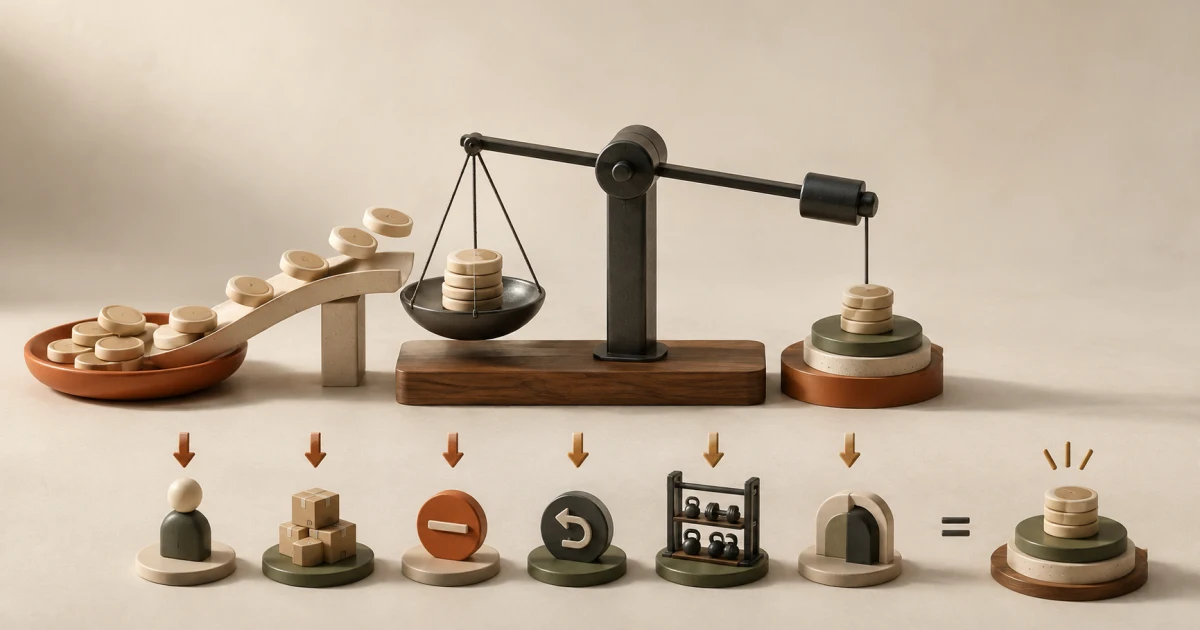

A rising average can occur because low-price members left, a few people bought personal training, taxes were included, or the active-member denominator changed.
Calculate ARPM from a stated revenue scope and average or period-end active-member denominator. Separate membership, coaching, retail, joining fees, tax, refunds, and non-member revenue; publish median and segments where concentration matters.
The owner decision is: What revenue and member population does this average represent, and what important distribution does it hide? This guide does not prescribe a universal benchmark. It gives the gym a record, calculation, or control it can test against its own people, service model, capacity, and evidence.
Use the Collection H roadmap
Pricing, Revenue Quality, and Forecasting is a ten-decision operating sequence. Each page owns a different question and original asset:
| Order | Guide | Working asset |
|---|---|---|
| 1 | How to Raise Gym Membership Prices Without Hiding Tradeoffs | Price-change decision and communication timeline |
| 2 | Grandfather Old Gym Prices or Migrate Everyone? | Grandfathering decision model |
| 3 | Gym Membership Mix Analysis: Monthly, Quarterly, Annual | Plan-mix dashboard |
| 4 | Average Revenue per Gym Member: Define It Before Using It | ARPM definition and worked examples |
| 5 | Gym Discount Leakage: Audit Deals and Extensions | Discount register and realized-price bridge |
| 6 | Corporate Gym Membership Sales: From Pilot to Renewal | Employer pilot and renewal scorecard |
| 7 | Test Family, Student, and Off-Peak Gym Plans | Special-plan economics test sheet |
| 8 | Is a New Gym Revenue Stream Actually Profitable? | New revenue-stream contribution test |
| 9 | Capacity-Based Gym Pricing: When Crowding Changes the Offer | Peak-capacity heat map and offer test |
| 10 | Gym Revenue Forecasting: Build Best, Base, and Worst Cases | Twelve-month scenario worksheet |
Use the collection pillar for the full sequence. The related plan mix, contribution margin, revenue forecast go deeper where this decision hands work to another process.
Define the record before interpreting it
| Term | Working definition |
|---|---|
| Revenue scope | Included collected or recognized revenue categories. |
| Active denominator | Member count under a fixed status and averaging rule. |
| ARPM | Included revenue divided by the defined member denominator. |
| Concentration | Share produced by a small member or service group. |
| Realized price | Actual net membership value, distinct from total ARPM. |
Keep the definition visible beside the data. If staff change a threshold, denominator, or evidence rule, record the effective date. A chart that quietly changes meaning is worse than a blank chart because it gives false confidence.
Run the operating sequence
| Step | What must happen | Accountable role |
|---|---|---|
| Scope | Choose collected or recognized basis and included categories. | Finance |
| Reconcile | Remove tax where appropriate, refunds, reversals, and non-member sales. | Accountant |
| Count | Calculate average active members consistently. | Data owner |
| Segment | Show membership, PT, plan, branch, and tenure views. | Owner |
| Interpret | Explain mix and concentration before action. | Owner |
“Team” is not an accountable role. Several people can contribute, but one role must own the next action, exception, and closure. At a handoff, the receiving role acknowledges the open item so responsibility does not vanish between shifts.
ARPM definition and worked examples
| Component | Include? | Amount | Denominator treatment | Caveat |
|---|---|---|---|---|
| Membership dues | ||||
| Personal training | ||||
| Retail and classes | ||||
| Joining fees | ||||
| Taxes, refunds, non-members |
Fill the blank cells from the gym’s actual records. Where a field needs professional review, name the reviewer and record the version. Do not turn a worksheet into a medical, legal, accounting, employment, or exercise prescription.
Work through a fictional example
A fictional gym collects ₹900,000 in membership dues, ₹180,000 in PT, and ₹60,000 in retail, with ₹40,000 refunds and 400 average active members. If eligible net revenue is ₹1,100,000, ARPM is ₹2,750. Membership-only realized revenue is ₹2,250. The distinction changes the pricing decision.
This example is fictional and is not an industry benchmark. It shows how the method behaves, including uncertainty. Replace it with a local sample and keep the source period, exclusions, and unresolved data visible.
Measure whether the decision improved
Track the following as a connected set:
- ARPM by revenue scope
- Average and period-end active denominator
- Membership-only realized price
- Median or segment revenue and concentration
- Refunds, discounts, tax treatment, and non-member sales
Compare like with like. Show cohort, time window, sample size, source, and operational change where they matter. A movement after an intervention is a signal to investigate, not automatic causal proof.
Protect the member, prospect, and team
- Do not mix collections and recognized revenue silently.
- Do not include tax as gym earnings without accounting review.
- Do not hide refunds or failed payments.
- Do not compare branches with different scopes.
- Do not treat an average as a typical member.
Gym records can expose routines, health context, financial difficulty, staff performance, and personal relationships. Collect the minimum needed for the stated decision, restrict access, define retention, and keep sensitive notes out of broad dashboards and handovers.
Put it into operation this week
- Write the revenue scope.
- Reconcile the active denominator.
- Calculate membership-only and total views.
- Add concentration and segment checks.
- Document every definition change.
At the review, inspect underlying records rather than accepting the summary alone. Keep “unknown” as a valid state, assign one corrective action, and decide when the next audit will show whether it worked.
Frequently asked questions
What is average revenue per gym member?
It is included gym revenue divided by a defined active-member denominator for a stated period. The revenue basis and member rule must be published.
Should PT revenue be included in ARPM?
It can be included in a total member-revenue view, but show membership-only and PT components separately so concentration and pricing remain visible.
Is ARPM the same as profit per member?
No. Revenue excludes acquisition, trainer labour, payment fees, consumables, space, refunds, tax, and other costs needed to calculate contribution or profit.