A member rarely disappears on the day their plan expires. First they miss a Monday. Then a week. Then the gym becomes a place they feel guilty about rather than a place they visit. The expiry date only confirms a decision that may have started much earlier.
Gym management software cannot prevent every member from leaving, but it can reduce avoidable churn by showing attendance drop-off, approaching expiry, unpaid balances, and missed follow-ups early enough for the gym to act. The system finds the signal. A person still has to handle the conversation well.
The short answer: Retention software is useful when it tells you who needs attention, why they may be at risk, and what the next human action should be. A dashboard alone does not retain anyone.
What member churn means in a gym
Gym member churn is the loss of active members over a period. Some churn is expected. People relocate, change jobs, recover from injuries, or choose a different way to train. Software cannot and should not pretend that every departure is preventable.
The preventable part usually comes from a broken process:
- Nobody noticed the member stopped attending.
- The first renewal message arrived after expiry.
- A payment dispute or pending balance was left unresolved.
- A trial member never received the promised follow-up.
- Staff assumed somebody else had called.
- The gym did not record why the member left.
These are visibility and accountability problems. That is where gym member retention software can help.
The four signals worth watching
1. Attendance has fallen
Attendance is not the same as satisfaction, but a sudden drop is a useful reason to check in. A member who used to visit four times a week and has not appeared for ten days deserves a different conversation from someone who regularly trains twice a month.
A digital gym attendance system gives that context without asking staff to count a paper register. The goal is not to label somebody as a quitter. It is to notice a change while a helpful conversation is still possible.
2. The membership is approaching expiry
An expiry list creates a clear follow-up window. The gym can contact the member before access ends, confirm whether they want to continue, and resolve questions while the habit is still active.
Timing matters more than volume. Sending the same message to every expiring member is less useful than knowing who is attending regularly, who has gone quiet, and who already has an unresolved issue. Our guide to gym membership renewal reminders covers the reminder sequence in detail.
3. Money is unresolved
Pending dues, failed collections, and unclear partial payments create friction. Sometimes the member thinks the plan is active while the front desk thinks money is still owed. Sometimes nobody is certain because the payment sits in a bank statement without a member record.
Retention starts with clarity. A payment history and visible balance let staff discuss the real situation without accusation or guesswork.
4. The promised follow-up never happened
Retention begins before the person becomes a member. If a trial visitor asks for pricing and the next action lives only in someone’s memory, the gym may lose the relationship before it starts.
The same applies later. A note such as “call after exams” or “freeze requested until 15 September” is only useful when it is attached to the person and visible to the staff member responsible for it.
A simple member retention workflow
Use software to create a short daily list, not another large report nobody opens.
Step 1: Review members who stopped visiting
Look for a meaningful change from the member’s normal pattern. A fixed rule such as no visit in 14 days is a practical starting point, not a diagnosis.
Step 2: Add the membership context
Check the expiry date, plan, recent payment status, and any staff notes. This prevents an awkward message to someone who is already frozen, travelling, injured, or waiting for a correction.
Step 3: Choose a human follow-up
The message should fit the situation:
- Inactive but still active: Ask whether training is going well and whether anything is getting in the way.
- Expiring soon and attending: Make renewal easy and confirm the preferred plan.
- Expiring soon and inactive: Lead with the absence, not the payment.
- Pending balance: Clarify the record and offer a simple way to settle it.
- Trial completed: Ask about the experience and the next goal.
Step 4: Record the outcome
Did the member renew, request a freeze, need a call later, or decide to leave? Record that outcome so another staff member does not restart the same conversation from zero.
Step 5: Review patterns monthly
Individual follow-ups help one person. Monthly patterns improve the gym. Look for common reasons members leave, the plans with weaker renewal, and the point at which attendance begins to drop.
Do not confuse correlation with cause. If members on one plan renew less often, the plan may be wrong, or that plan may simply attract people with different goals. The report tells you where to investigate.
What software cannot do for retention
Software cannot repair a poor member experience. It cannot replace coaching quality, equipment maintenance, cleanliness, a welcoming front desk, or a programme that helps the member progress.
It also cannot safely infer a person’s motivation from attendance alone. Someone may be travelling, ill, training elsewhere, or following a different schedule. Treat every signal as a reason to ask, not as permission to pressure.
Avoid these mistakes:
- Sending repeated automated messages without context.
- Contacting inactive members only to ask for money.
- Treating every missed visit as a churn prediction.
- Measuring staff by message volume instead of resolved outcomes.
- Offering a discount before understanding the real objection.
- Collecting departure reasons and never reviewing them.
The retention numbers that are useful
You do not need a complicated analytics suite to start.
| Measure | What it answers | Useful action |
|---|---|---|
| Expiring in the next 7 days | Who needs a timely renewal conversation? | Assign follow-up today |
| No visit in 14 days | Who may be losing the habit? | Check context and contact personally |
| Renewal rate | What share of eligible members continued? | Compare periods and investigate changes |
| Freeze requests | Is absence temporary rather than churn? | Preserve the relationship correctly |
| Exit reason | Why did the member say they left? | Fix repeated operational problems |
| Rejoined members | Which former members came back? | Learn which win-back actions worked |
To calculate a basic renewal rate, divide members who renewed during the period by members whose plans were eligible to renew, then multiply by 100. Define the period and eligibility rule consistently, or comparisons will be misleading.
How Gym Ledger supports retention work
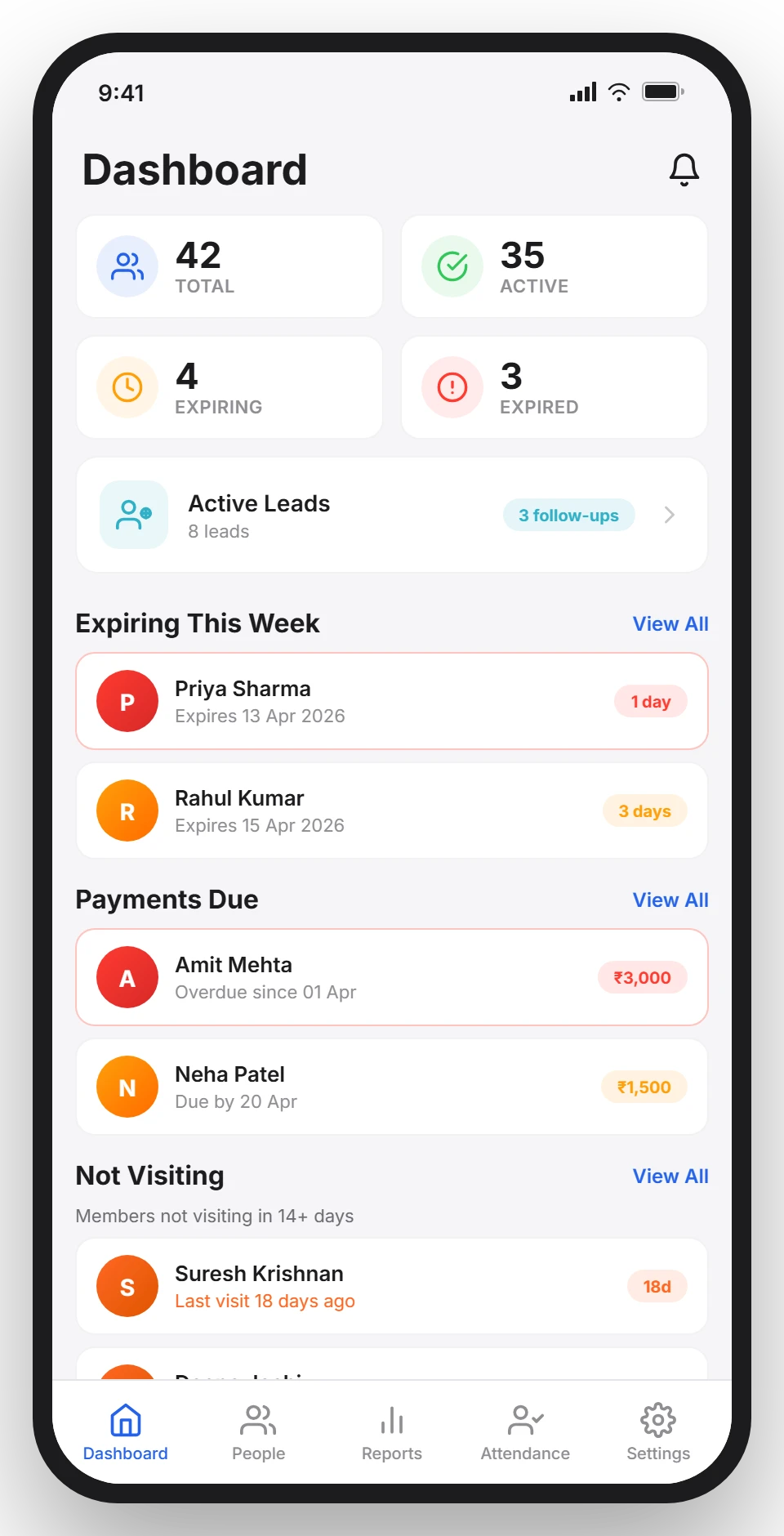
Gym Ledger brings the practical signals together: expiring memberships, pending dues, attendance history, members who have not visited recently, follow-up notes, and renewal status. Staff permissions let the owner decide who can view or change each area.
It does not claim to read a member’s mind or guarantee retention. It gives the gym an earlier, cleaner list of people worth speaking to. That is a realistic role for software.
If attendance is still on paper, begin with the digital attendance guide. If the immediate leak is expiry follow-up, start with the renewal reminder process.
Frequently asked questions
Can gym management software prevent member churn?
It can reduce avoidable churn by showing attendance drop-off, approaching expiry, pending balances, and missed follow-ups early enough for staff to act. It cannot prevent every departure or replace a good member experience.
How does attendance data help gym retention?
Attendance data shows when a member’s visit pattern changes or stops. That gives the gym a reason to check in before the membership expires, while avoiding the assumption that absence always means the person intends to leave.
What is an at-risk gym member?
An at-risk member is someone showing a practical signal that deserves attention, such as a sharp attendance drop, an approaching expiry, an unresolved payment, or a missed follow-up. The label should prompt a conversation, not an automatic sales message.
What should gym staff say to an inactive member?
Start with the member’s experience rather than the renewal. Ask whether training is going well and whether anything is getting in the way. Check the person’s plan, attendance, notes, and payment context before contacting them.