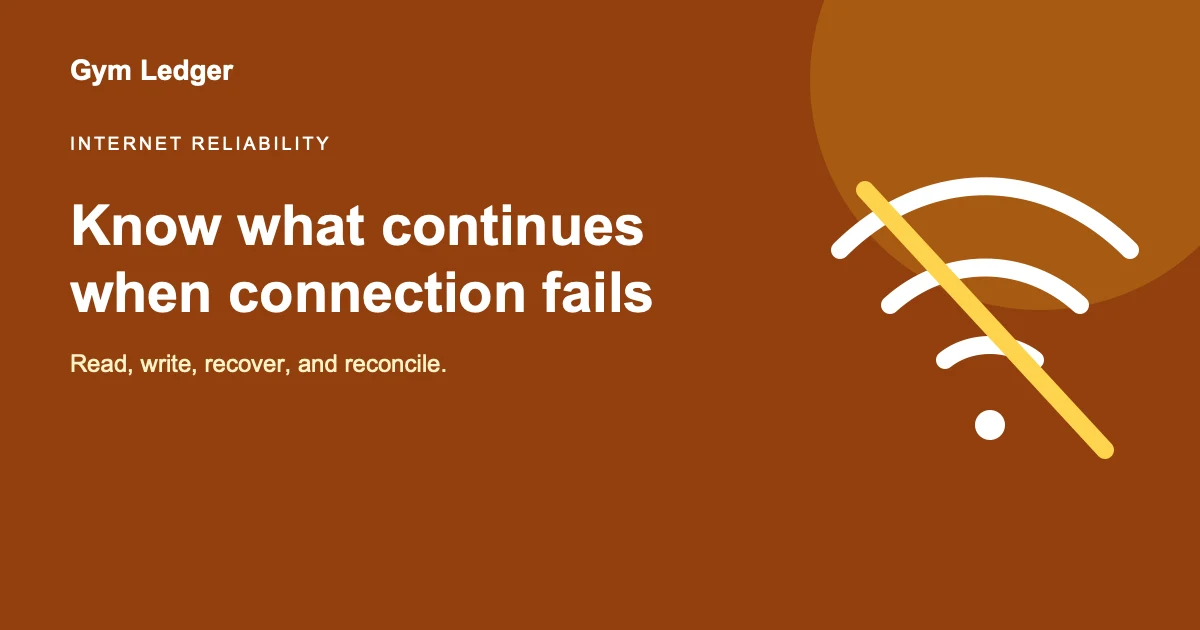
The connection drops as reception records a payment. A dangerous system looks successful locally, retries later, and creates uncertainty about whether the member was charged or activated twice.
When internet service is unreliable, evaluate every gym software action separately: what can be read, what can be written, what must wait, how conflicts are handled, and how staff reconcile after connectivity returns. A single availability label cannot describe all of that.
The short answer: Test member lookup, check-in, payment, correction, and recovery under a controlled connection failure.
Read access and write access are different
Some systems show recently cached information while disconnected but require connectivity for new entries. Others support a limited local operating mode or an on-site server. The safest behavior depends on the action.
Viewing a previously loaded member is lower risk than confirming money, changing an expiry, or granting door access. Ask for a written action-by-action matrix.
The five tests to run
Member lookup
Can staff identify the correct member and see whether the information is current? Does the screen disclose stale or unavailable data?
Check-in
Can a valid member enter, and how are expiry or freeze rules applied? Access-control systems may have separate local behavior that must be tested with the hardware vendor.
Payment
Never infer capture from a loading screen or screenshot. Determine whether the provider, bank, and gym record agree before issuing a final receipt or extending membership.
Conflicting edits
If two devices change the same member, which value wins? The system should not silently erase one action.
Recovery
After connection returns, pending, failed, rejected, and completed actions should be visible with timestamps and actors. Duplicate prevention and audit history are essential.
Write a continuity procedure
Define what staff may continue, what must wait, which temporary evidence can be recorded, who reconciles it, and when the gym returns to normal operation. Keep the procedure small enough to use during a busy shift.
Do not maintain an uncontrolled second database. A temporary log should have a clear owner and be destroyed securely after reconciliation according to policy.
Gym Ledger connectivity behavior
Gym Ledger may display some previously cached information, but new records and changes require an active connection. They are not held for automatic later submission. Staff should wait for connectivity before recording a payment, member change, or attendance action.
That behavior favors consistency over pretending a write completed. A gym with prolonged outages or mandatory local access should evaluate a system designed for that requirement and test it in the actual facility.
Frequently asked questions
Can gym management software be used during an internet outage?
It depends on the product and action. Some systems allow limited cached reading, some provide controlled local operations, and others require connectivity. Test member lookup, check-in, payments, corrections, and recovery separately.
What should gym staff do when the connection fails?
Follow a written continuity procedure that identifies what can continue safely, what must wait, how temporary evidence is recorded, who reconciles it later, and how duplicate actions are prevented.
How should software recover after connectivity returns?
It should make pending or rejected actions visible, prevent duplicates, preserve timestamps and actors, resolve conflicts predictably, and provide an audit trail for reconciliation.
How does Gym Ledger behave with poor connectivity?
Gym Ledger can show some previously cached information, but new entries and changes require an active connection and are not queued for later submission. Staff should wait for connectivity before recording the action.