The member exists in billing, booking, the door system, coaching, and email, but every tool has a different expiry date. Five integrations have produced no single truth.
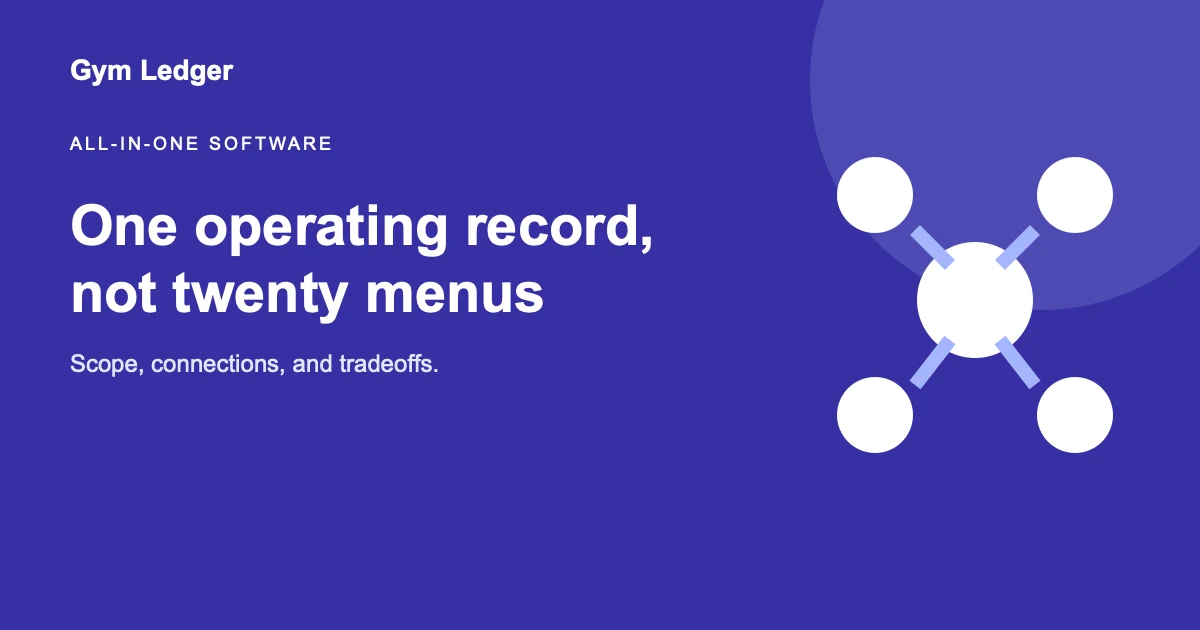
All-in-one gym management software aims to connect most gym workflows around shared member, membership, transaction, attendance, and staff records. Its value comes from integration and consistency, not the number of modules advertised.
The short answer: Choose the scope your business needs and verify that one action updates every related module correctly.
What all-in-one can include
- Lead capture and CRM.
- Memberships, freezes, renewals, and contracts.
- Billing, payment processing, dues, invoices, and receipts.
- Attendance and physical access control.
- Classes, bookings, rooms, resources, and waitlists.
- Personal training, programs, workouts, and progress.
- Member app or portal.
- Staff roles, schedules, tasks, and compensation context.
- Email, messaging, and marketing automation.
- Retail point of sale and inventory.
- Expenses, analytics, tax context, and exports.
- Multi-location and franchise controls.
Few gyms need equal depth in all areas. A class studio, open-floor gym, 24-hour club, and coaching business have different centers.
Benefits of one platform
Connected records reduce duplicate entry and conflicting status. Staff learn fewer systems. Reporting can follow a lead into membership, payment, attendance, and renewal. Security and account removal can be managed more consistently.
These benefits disappear when modules are loosely connected, use different identifiers, or require frequent spreadsheet repairs.
Tradeoffs
A broad platform can cost more, take longer to configure, and make common tasks harder. Specialist booking, coaching, accounting, marketing, or access systems may offer deeper workflows.
Integrations create their own responsibilities: field mapping, duplicate prevention, error monitoring, consent, and ownership when one provider changes an API.
Trial the connection, not the modules
Create one member, payment, booking or workout, attendance event, renewal, refund, and report. Change the membership status and verify each downstream surface. Remove a staff account and check access everywhere. Export the complete history.
Use the essential features checklist and platform comparison method to score results.
Is Gym Ledger all-in-one?
Gym Ledger connects core gym operations: members, payments recorded by the gym, partial dues, renewals, attendance, leads, staff, trainers, workout plans, member access, expenses, and reports.
It does not claim class booking, inventory, member payment processing, wearable sync, multi-branch, or full electronic contract signing. It can be an integrated core for a small gym, but it is not universal software for every fitness business model.
Frequently asked questions
What is all-in-one gym management software?
It is a platform intended to connect most gym workflows, such as leads, members, billing, attendance, booking, access, coaching, communication, staff, retail, and reporting, around shared records.
What should an all-in-one gym platform include?
The correct scope depends on the business. Core capabilities usually include members, money, attendance, staff access, reporting, exports, security, and support, with booking, access, coaching, marketing, and retail added when required.
Is all-in-one software better than separate tools?
It reduces duplicate data when modules are genuinely connected. Separate specialist tools can be stronger for complex booking, coaching, accounting, or marketing if integrations and ownership are well managed.
Is Gym Ledger an all-in-one platform?
Gym Ledger connects core gym operations including members, gym-recorded payments, renewals, attendance, leads, staff, trainers, workout plans, expenses, member access, and reports. It does not claim class booking, inventory, member payment processing, wearable sync, multi-branch, or full contract signing.